What Is On-Device AI? How Your Smartphone Processes AI Without the Internet — Benefits and Limitations Explained
An overview of on-device AI, how it differs from cloud AI, the role of NPUs, pros and cons, and real-world use cases and adoption by Samsung, Apple, and Qualcomm.
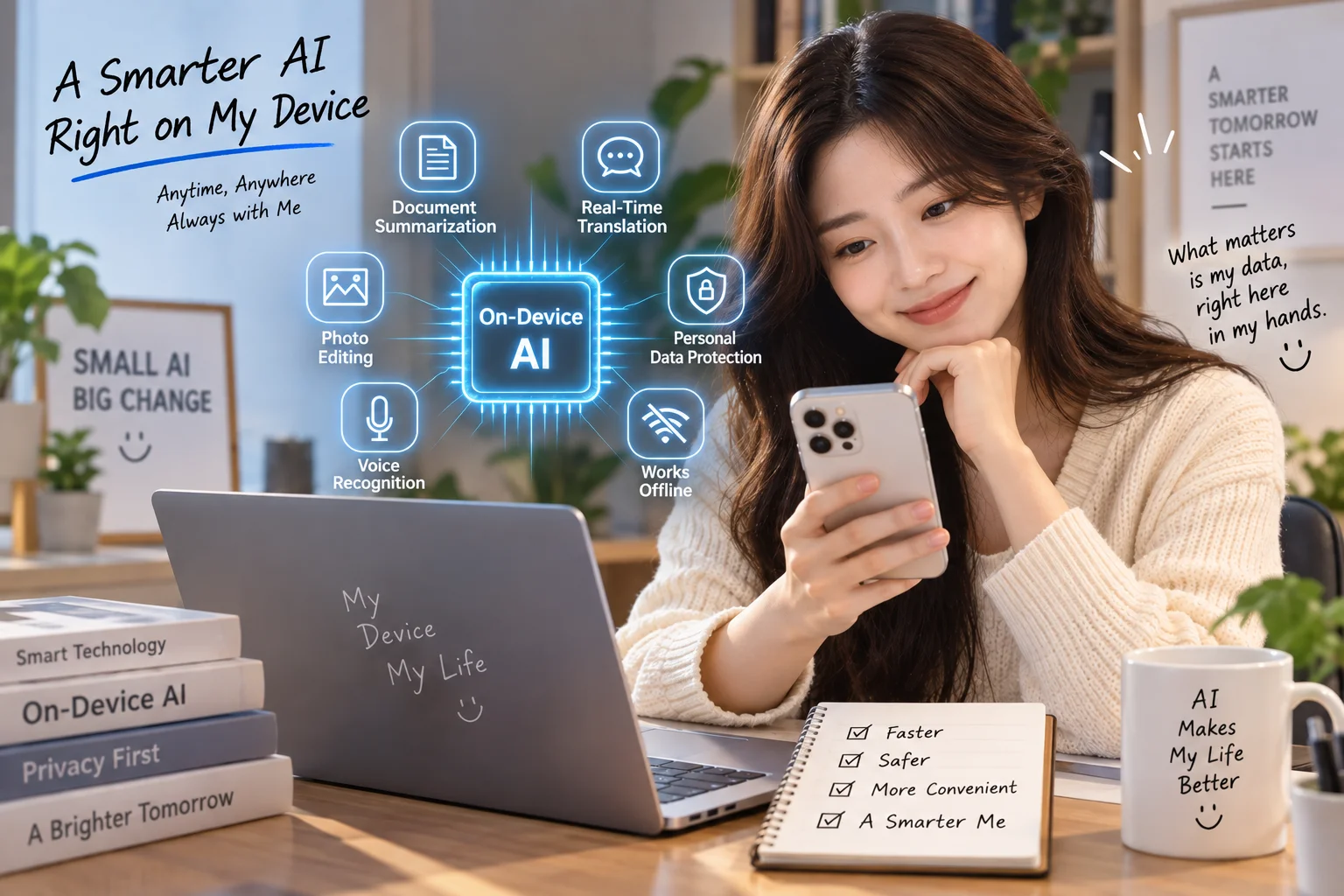
[ This image was created using generative AI ]
Can a smartphone really run AI without an internet connection?
Until a few years ago, "using AI" almost always meant being connected to the internet. You'd type a question into a chatbot, that input would travel over the internet to a massive server somewhere, the server would compute an answer, and then send it back to you. But lately, when shopping for a new smartphone or laptop, you may have noticed phrases like "supports on-device AI."
On-device AI works a bit differently. Instead of sending data back and forth over the internet, it processes AI computations directly inside your smartphone, laptop, or even your car or refrigerator. In this post, we'll break down exactly what this concept means, how it differs from the traditional approach, and how various companies are actually implementing it today.
What is on-device AI?
On-device AI refers to running an AI model's inference (computation) directly on a device's own hardware, rather than on a cloud server. In contrast, the more familiar approach — sending a question or data over the internet to an external server for processing and then receiving the result — is called cloud AI.
A simple analogy: if cloud AI is like "mailing your question to a distant expert through the post office and waiting for a reply," on-device AI is more like "solving the problem yourself with a calculator sitting on your desk." Just as a more powerful calculator can handle more complex problems on the spot, the better a device's AI processing capability, the more tasks it can complete entirely on its own.
You may also come across the term Edge AI in this context, which refers more broadly to processing AI at the "edge" of the network — sensors, cameras, vehicles, and so on — rather than in a centralized data center. On-device AI is generally used to describe the subset of edge AI that runs specifically on personal devices used by individuals.
What's the difference between cloud AI and on-device AI?
The comparison is easiest to see in a table.
Comparison | On-Device AI | Cloud AI |
|---|---|---|
Where processing happens | Inside the device (smartphone, PC, etc.) | External data center servers |
Internet required | Not required (for supported features) | Required |
Response speed | Fast, since there's no network latency | Can be delayed depending on network conditions |
Personal data handling | Data stays on the device | Data is transmitted to a server |
Size of AI models supported | Relatively limited due to device constraints | Can run large-scale models |
Server cost | Lower burden for companies | Significant infrastructure cost |
Battery/heat impact | Directly affects the device's battery and heat | Minimal impact on the device itself |
Importantly, most real-world products don't rely purely on one approach or the other. Instead, they use a hybrid structure that combines on-device and cloud AI depending on the task. We'll go into more detail on this in the company examples below.
What is an NPU (Neural Processing Unit), and why does it matter?
The hardware that has made on-device AI possible is a specialized chip called the NPU (Neural Processing Unit).
A CPU (central processing unit) is a general-purpose processor designed to handle a wide variety of computations, while a GPU (graphics processing unit) is optimized for graphics rendering and large-scale parallel computation. An NPU goes a step further — it's a chip specifically designed to handle the matrix operations that deep learning models rely on, doing so quickly and with low power consumption.
Put simply, if a CPU is an "all-purpose worker" and a GPU is a "worker skilled at graphics and bulk tasks," an NPU is a "worker that specializes exclusively in AI computation." Because NPUs handle the same AI operations with much less battery drain and heat than a CPU or GPU would, they're especially important in battery-powered devices like smartphones and laptops.
In fact, Microsoft's official specification for its Copilot+ PC category sets a benchmark of an NPU capable of at least 40 TOPS (40 trillion operations per second) — a minimum requirement it states is needed to run AI features like real-time translation and image generation directly on the device (per official Microsoft documentation).
Can you use AI features without an internet connection?
The short answer is: for some features, yes — but it's important to distinguish this from "every AI feature on that device works offline."
For example, Google's lightweight AI model Gemini Nano is built to run on top of a system service on Android called AICore, using the device's own hardware. This allows apps to perform tasks like summarization and text generation entirely offline, without calling a server (per official Google Android Developers documentation). Apple similarly states that many Apple Intelligence features — such as text summarization and notification-priority ranking — are processed entirely on the device, meaning the data never leaves it.
That said, more complex requests — for example, sophisticated reasoning tasks or generating detailed images — can exceed what a device's own hardware can handle. In these cases, Apple has officially stated that it routes the request to its own server system, Private Cloud Compute, as part of a hybrid architecture. In other words, a device "supporting on-device AI" doesn't mean "every AI feature works without the internet" — that's a distinction worth keeping in mind.
The privacy advantage
One of the biggest reasons on-device AI has drawn attention is how it handles personal data.
Cloud AI requires sending data — questions, photos, documents — to an external server, which inherently introduces some risk during transmission or server-side storage that can't be fully eliminated. On-device processing, by contrast, keeps data on the device itself, which reduces the number of pathways through which that data could potentially leak.
Apple states in its official documentation that "for many tasks, processing happens directly on your iPhone, iPad, or Mac, so your personal data never leaves your device." Google similarly notes that on-device generative AI "enhances privacy by keeping sensitive data on the device." That said, this should be understood as "reducing the risk of leakage" rather than "on-device processing means zero security concerns" — those are different claims. Even Apple applies strong security design and a transparency logging feature specifically to the Private Cloud Compute portion of its system, which handles more complex requests.
Impact on speed and battery life
In terms of speed, on-device AI eliminates the round-trip time to a server, so it can respond fairly reliably even in poor network conditions. However, this only means there's no network latency — if the device's own processing power is weak, it could still end up slower than a powerful cloud server.
In terms of battery and heat, running AI computations on-device does place a direct load on the device's own resources. NPUs exist specifically to reduce this burden — the key reason for including one is that it processes the same computations more power-efficiently than a CPU or GPU would.
Limitations and drawbacks of on-device AI
On-device AI isn't without downsides. Confirmed limitations include:
Constraints on model size: A device's memory and processing power are limited compared to data center servers, so very large AI models generally can't run directly on a device as-is. This is why on-device models are typically lightweight, scaled-down versions of larger models (often called sLMs, or small language models).
Uneven support across devices: Older devices with weak or no NPU often can't support the same on-device AI features available on newer hardware.
Higher device cost: Adding dedicated hardware like an NPU can increase component costs.
Not always fully offline: As noted above, complex tasks are still commonly routed to the cloud as part of a hybrid structure.
Real-world use in smartphones, PCs, cars, and appliances
Smartphones: Samsung's Galaxy AI, Apple's Apple Intelligence, and Google's Gemini Nano are prominent examples.
PCs: Microsoft's Copilot+ PC category (requiring an NPU of 40+ TOPS) and NVIDIA's RTX AI PC (running AI locally via GPU) are two notable approaches.
Automobiles: On-device AI concepts are used in advanced driver-assistance systems (ADAS) that analyze camera and sensor data directly within the vehicle to provide features like lane-departure warnings and pedestrian detection. That said, exact processing speeds and specifications vary by manufacturer and model, so this article doesn't assert specific figures.
Home appliances: Samsung has showcased Bespoke appliance lineups incorporating on-device AI — for example, refrigerators with internal cameras that recognize food items — at events such as CES (per Samsung's own public presentations).
How major companies are applying on-device AI
Apple processes many Apple Intelligence features through its on-device Neural Engine. The A19 chip, unveiled in September 2025, features a 16-core Neural Engine that Apple states delivers 35 trillion operations per second (35 TOPS). The A20 Pro, unveiled in September 2026, adds a 32-core Neural Engine along with neural accelerators built into the GPU, further boosting performance. However, Apple has clearly stated that more complex requests are routed to its own server system, Private Cloud Compute, as part of a hybrid architecture — so Apple's on-device AI should be understood not as "entirely offline," but as "process as much as possible on-device, and fall back to a security-hardened server when needed."
Samsung Electronics expanded Galaxy AI through the Galaxy S25 lineup and One UI 7, and has officially stated a goal of bringing Galaxy AI to 400 million devices by the end of 2025. At MWC 2026, the company also announced further expansion of the Galaxy AI ecosystem.
Google offers Gemini Nano to developers through Android's AICore service and the ML Kit GenAI API, with support extending beyond Pixel devices to select phones using Qualcomm Snapdragon and MediaTek Dimensity chips. In 2026, Google announced it would add the lightweight Gemma 4 model to the AICore Developer Preview.
Qualcomm officially states that the Hexagon NPU in its Snapdragon X Elite/Plus platforms for laptops delivers up to 45 TOPS of performance. The company has also announced plans for a next-generation Hexagon NPU aimed at running Mixture-of-Experts (MoE) models with up to 30 billion parameters — though it's worth noting this is a stated future goal, not a confirmed, currently shipping performance figure.
Intel states that the NPU in its Core Ultra 200V (Lunar Lake) delivers 48 TOPS, while its Core Ultra Series 3 (Panther Lake, built on the 18A process), officially launched at CES in January 2026, offers up to 50 TOPS (INT8) of NPU performance.
AMD officially states that the NPU in its Ryzen AI 300 series (XDNA2 architecture) delivers up to 50 TOPS, while its Ryzen AI Max+ and Ryzen AI 400 series deliver up to 60 TOPS.
NVIDIA, rather than focusing primarily on smartphones or laptops, is expanding its on-device and edge AI presence through GPU-based "RTX AI PCs" and its Jetson platform, which is geared toward robotics and industrial edge computing.
The relationship between generative AI and on-device AI
Generative AI refers to AI that creates new content — text, images, code, and more. Large generative AI models, like the ones behind well-known chatbots, traditionally required data-center-scale servers due to their massive parameter counts.
Recently, there's been a growing trend toward creating lightweight versions of these generative models — often called small language models (sLMs) — that can run directly on smartphones and PCs. Google's Gemini Nano and Apple's on-device foundation models mentioned above are prime examples. That said, these lightweight models still can't fully replace the complex reasoning or creative capabilities of massive cloud-based models. The current industry norm is a hybrid approach: simple tasks handled on-device, complex tasks handled in the cloud.
Looking ahead
Before going further, it's worth being clear: what follows is industry outlook, not confirmed fact.
Apple, Qualcomm, and other chipmakers and device manufacturers continue to release new hardware with improved NPU performance each year, and as seen with Qualcomm's stated goals, there are ongoing efforts to run larger models directly on devices. Given this trend, the industry generally expects the scale of AI models that can run on-device to keep growing. However, this is a prediction that depends on the pace of semiconductor advances and each company's actual commercialization decisions — it is not a settled fact.
It also seems plausible that the hybrid structure used by Apple's Private Cloud Compute and Google's AICore — process on-device by default, and offload to the cloud only when necessary — could become a shared direction among major companies going forward. But this, too, is subject to change based on each company's future strategy.
What changes can consumers expect?
As of the time of writing (August 2026), the following changes are already observable:
When purchasing a recent flagship smartphone or an "AI PC," you may be able to use certain AI features — like summarization, translation, or image editing — without an internet connection.
However, this support is generally limited to newer devices that meet specific NPU performance thresholds (such as the 40 TOPS requirement for Copilot+ PCs), not all devices.
Which AI features are processed on-device versus sent to a server varies by manufacturer, so if you're working with sensitive data, it's worth checking the manufacturer's official privacy policy.
Key takeaways
On-device AI processes AI computations directly on a device, while cloud AI processes them on an external server.
The key component enabling on-device AI is the NPU, a dedicated chip designed to handle AI computations efficiently with low power consumption.
On-device AI allows some features to work without an internet connection and offers privacy advantages since data doesn't leave the device.
However, due to hardware limitations, the size of models that can run on-device is constrained, and a hybrid structure combining on-device and cloud processing remains the norm for complex tasks.
Samsung, Apple, Google, Qualcomm, Intel, AMD, and NVIDIA are each applying on-device AI in their own way across smartphones, PCs, and appliances, and the underlying technology continues to evolve.