What Is Physical AI? Why Robots That Can See, Reason, and Act Are Getting So Much Attention
Physical AI connects AI with sensors and machines, enabling systems to perceive, plan, and act in the real world.
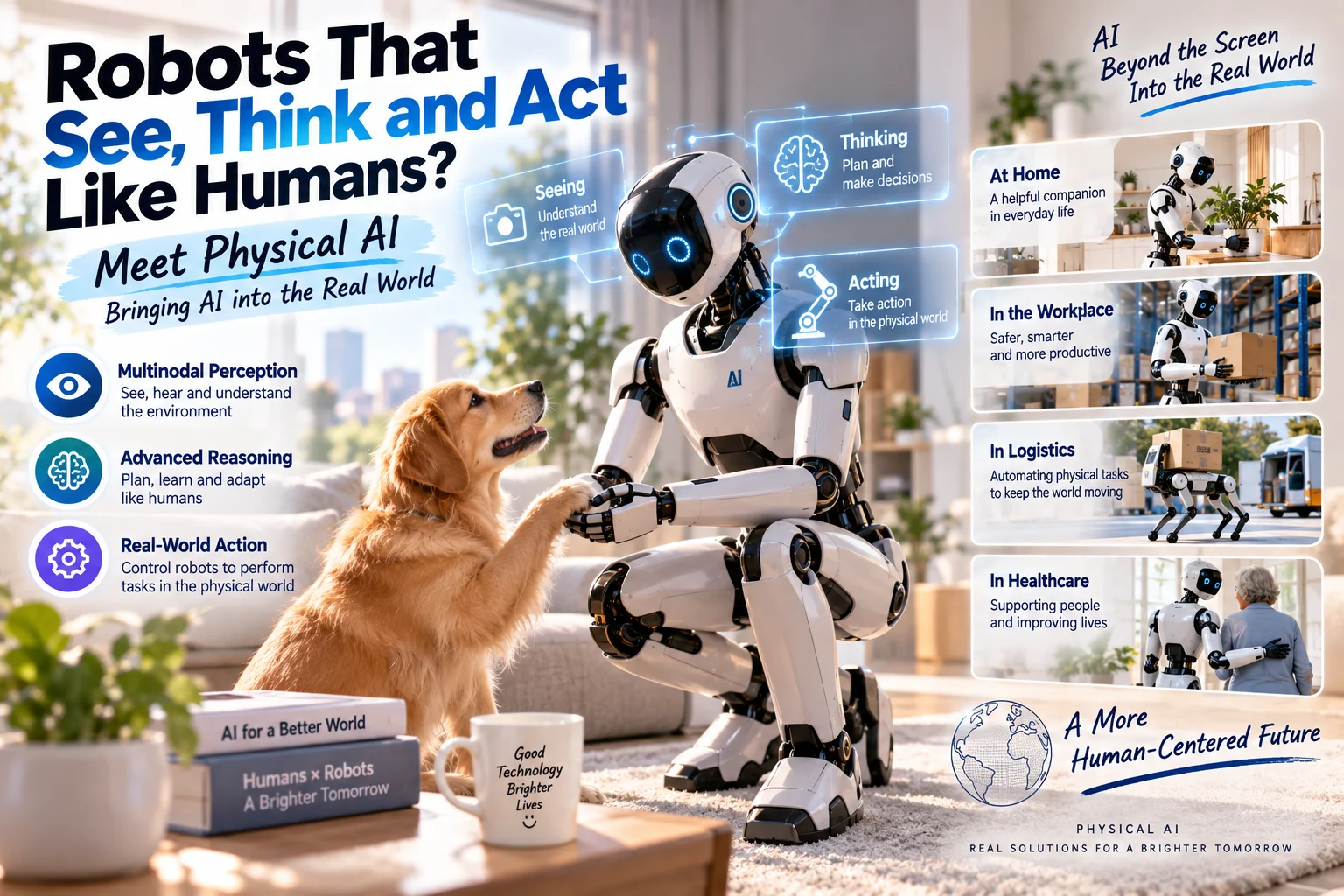
[ This image was created using generative AI ]
What if you could simply tell a robot, “Bring me a bottle of water from the kitchen,” and it could look around, understand the request, find the bottle, avoid obstacles, pick it up, and bring it back?
That idea is at the center of a rapidly growing field often described as Physical AI.
Generative AI has taught computers to create text, images, audio, video, and software. Physical AI attempts to connect increasingly capable AI models to cameras, sensors, motors, vehicles, robotic arms, and other machines so that AI can interact with the real world.
The technology is progressing quickly, but the current state of robotics needs to be described carefully.
As of August 2026, commercially deployed robots already perform useful work in warehouses, factories, and autonomous vehicles. General-purpose humanoids, however, remain much earlier in their development. Many are still being trained, tested, or deployed in small numbers for specific tasks rather than working with human-level flexibility.
What exactly is Physical AI?
There is no single universally standardized definition of “Physical AI.”
NVIDIA describes physical AI in robotics as enabling robots and autonomous systems to perceive, reason, learn, and act in the physical world. Google DeepMind often discusses related ideas using terms such as “physical agents” and “embodied reasoning.”
For a general reader, a useful definition is:
Physical AI is AI that receives information about the real world through sensors, makes decisions or plans based on that information, and connects those decisions to the actions of a physical machine.
The physical system could be a humanoid robot, an industrial arm, a warehouse robot, an autonomous vehicle, or another type of machine.
This is what makes Physical AI different from AI that only produces digital output.
Generative AI vs. Physical AI
Imagine asking an AI:
“Go to the kitchen and bring me a bottle of water.”
A conventional generative AI system can explain how the task should be done.
A physical robot has a much harder problem.
It has to determine where the kitchen is.
It needs to identify the water bottle.
It must distinguish that bottle from other objects.
It has to decide how to get there without hitting furniture or people.
Its arm and hand must approach the bottle correctly, grip it with enough force to hold it without crushing or dropping it, and then transport it back to the user.
And while doing all of this, the system needs to keep checking whether reality still matches its expectations.
That creates a continuous loop:
Perceive → understand → plan → act → observe the result → adjust
This feedback loop is one of the defining challenges of Physical AI.
A language model can regenerate an incorrect sentence. A physical machine making a bad decision can drop an object, damage equipment, or hurt someone.
Physical AI is not the same thing as a humanoid robot
Several related terms are often mixed together.
Generative AI creates new digital content such as text, images, audio, or video.
Robotics is the broad engineering field covering robot mechanics, sensing, control systems, software, and automation.
A humanoid robot is simply a robot with a body designed around some aspects of human form.
An AI agent is a system that can receive a goal, analyze information, make a plan, and carry out a sequence of tasks.
Physical AI describes AI connected to physical perception and physical action.
A humanoid can use Physical AI, but a humanoid and Physical AI are not the same thing.
In fact, some of the most commercially mature examples of Physical AI do not look human at all.
How does an AI robot see and move?
Consider a robot that has been asked to move a cup from one side of a table to another.
First, cameras and other sensors observe the scene.
Computer vision systems analyze those images to identify the cup, the table, nearby objects, and free space.
The system then decides what sequence of actions is required.
A robot controller translates those decisions into movements of joints, motors, and a gripper.
Once the cup has been moved, the sensors check the result.
If the object is not where expected, the robot may need to correct its movement.
This is a simplified example. Real robots may use multiple AI models and control systems operating at very different speeds. High-level AI might plan a task while specialized low-level controllers handle balance, motor torque, and precise joint movements.
Computer vision and multimodal AI give robots more context
Computer vision allows AI systems to analyze images and video and identify objects, people, surfaces, and spatial relationships.
Multimodal AI goes further by processing several types of information together, including text, images, audio, video, and sensor data.
Suppose someone says:
“Put the blue box on the shelf to your left.”
The robot must connect words such as “blue,” “box,” “left,” and “shelf” with objects and positions in the real environment.
That ability to connect language with physical space is one reason recent multimodal models are so important to robotics.
What is a Vision-Language-Action model?
One of the most important terms in modern robotics AI is VLA, short for Vision-Language-Action.
A VLA model attempts to connect:
Vision — what the robot sees
Language — what a human asks it to do
Action — how the robot should physically move
Google DeepMind's Gemini Robotics models and NVIDIA's GR00T work are prominent examples of this broader direction.
Traditionally, many robots have been programmed for carefully defined tasks and environments.
A VLA-based system aims to make that interaction more flexible. Instead of specifying every movement manually, a person could give a higher-level instruction and the AI could determine how to translate it into robot behavior.
This does not mean today's VLA models can make any robot instantly perform any task in any environment.
Generalization remains one of robotics' hardest problems.
Why is Physical AI attracting so much attention now?
Physical AI is not the result of a single breakthrough.
Several technologies are advancing at the same time.
Large AI models have improved planning and language understanding
Large language and multimodal models have become much better at understanding natural instructions and breaking complex goals into smaller steps.
Robotics researchers are now trying to connect those capabilities to machines.
Vision and multimodal models have improved
Robots increasingly need to understand not just individual objects but the relationships between objects, people, and spaces.
Modern multimodal AI makes it easier to combine visual information with human instructions.
AI computing has become much more powerful
Robots must process sensor data and generate decisions quickly.
More powerful GPUs and edge computing platforms make it possible to run increasingly sophisticated AI models closer to the robot itself.
Simulation is getting more important
Training entirely on real robots is expensive, slow, and sometimes dangerous.
Simulation allows developers to create virtual environments in which robots can practice movements, generate training data, and test failures before hardware is deployed.
NVIDIA's robotics stack, for example, combines technologies such as Isaac, Cosmos, and accelerated computing for robot training, simulation, and deployment.
Robotics companies are collecting more physical-world data
Language models could learn from huge amounts of text already available on the internet.
Robot data is much harder to obtain.
Developers need information about movement trajectories, joint positions, object contact, force, failures, and how people physically perform tasks.
That is why robotics companies are investing heavily in teleoperation, human demonstrations, synthetic data, simulation, and large-scale robot data collection.
Hardware is improving too
AI software alone cannot create a useful robot.
Motors, actuators, batteries, hands, cameras, force sensors, tactile sensors, and embedded computers also need to become more capable, reliable, and affordable.
Physical AI therefore sits at the intersection of AI and mechanical engineering.
What is actually available today?
This is where it is important to separate research demonstrations, pilots, and commercial deployments.
NVIDIA: infrastructure for building Physical AI
NVIDIA is developing many of the building blocks rather than a single consumer humanoid robot.
Its robotics ecosystem includes Isaac, GR00T, Cosmos, simulation tools, and Jetson computing platforms.
These technologies are designed to help developers collect data, train robot policies, test them in simulation, and run AI on actual machines.
This is evidence that the development stack for Physical AI is becoming more sophisticated. It is not evidence that fully general robots have already been solved.
Google DeepMind: extending Gemini into robotics
In July 2026, Google DeepMind announced its Gemini Robotics 2 family.
Gemini Robotics 2 is a Vision-Language-Action model designed to connect visual and language information with motor control.
Gemini Robotics ER 2 focuses on embodied reasoning, planning, and coordination in physical environments.
Google has demonstrated whole-body control, dexterous manipulation, and collaboration between robots. These remain examples of advanced robotics research and development rather than proof that a general-purpose household robot is already commercially available.
Amazon: robotics is already operating at huge scale
Warehouses offer one of the clearest examples of real-world robotics.
Amazon says it has deployed more than one million robots across its operations network.
These include mobile robots that transport inventory and robotic systems that pick, sort, and handle products.
Amazon's Vulcan system combines vision with force and contact sensing to manipulate inventory.
In 2026 the company also revealed a new version of Proteus that can receive natural-language instructions. However, that next-generation system is currently being piloted, with European deployment planned for the first half of 2027.
That distinction matters: Amazon already uses robotics at scale, but every newly announced AI capability is not automatically deployed throughout its network.
Agility Robotics Digit: a limited but genuine commercial humanoid deployment
Agility Robotics' Digit provides a useful example of how humanoids are entering industry.
GXO Logistics signed a multi-year agreement with Agility in 2024 and deployed Digit robots into live warehouse operations.
The robots perform clearly defined tasks such as moving totes from other automated equipment onto conveyors.
Agility later reported that Digit had moved more than 100,000 totes during the deployment.
That is a significant operational milestone, but Digit should not be mistaken for a general warehouse worker that can autonomously handle every job a human employee can perform.
Boston Dynamics Atlas: moving from research toward industrial deployment
Boston Dynamics introduced the product version of its electric Atlas humanoid in January 2026.
On September 21, 2026, the company announced the opening of the Robotics Metaplant Application Center at Hyundai Motor Group Metaplant America in Georgia.
Atlas robots are now being trained in a real manufacturing environment, including work related to automotive parts logistics and sequencing.
Reuters has reported that Hyundai plans to begin deploying Atlas into manufacturing operations from 2028.
So Atlas is an important industrial development, but describing it as already operating at large scale throughout Hyundai factories in 2026 would be premature.
Figure and BMW: factory work is real, but task scope matters
Figure has also tested and deployed humanoid robots in BMW's Spartanburg plant.
Figure says its Figure 02 robots performed a sheet-metal loading task during a deployment in 2025. The company later retired that generation and brought Figure 03 to the BMW facility in 2026 for more advanced logistics demonstrations.
Again, this is evidence of real factory experimentation and increasingly capable robot systems, not evidence of completely autonomous general-purpose workers.
Autonomous vehicles are also Physical AI
Physical AI is often associated with humanoids, but autonomous vehicles may actually be one of its most mature applications.
A self-driving vehicle observes the road using cameras and other sensors, identifies vehicles and pedestrians, plans a route, and translates those decisions into steering, braking, and acceleration.
That is exactly the kind of perception-to-action loop that defines Physical AI.
By September 2026, Waymo was operating paid driverless services in multiple U.S. cities and expanding public access to additional locations.
Even here, however, autonomy has boundaries. Robotaxi systems operate within defined geographic areas and operating conditions rather than demonstrating unrestricted human-level driving everywhere.
Why are companies so interested in humanoid robots?
The world has already been designed around the human body.
Doors, stairs, shelves, workbenches, tools, vehicles, and factories were largely built for people.
A robot with roughly human proportions may therefore be able to work in existing environments without requiring every facility to be redesigned around automation.
But humanoid form is not automatically the best engineering solution.
A wheeled robot may be cheaper and more energy-efficient for transporting loads.
A fixed industrial arm may be faster and more precise for repetitive assembly.
Humanoids make the most sense when their human-compatible shape provides a practical advantage.
Where could Physical AI be used?
Manufacturing is likely to remain an important early market for material handling, machine tending, inspection, and repetitive assembly support.
Logistics already uses large numbers of robots, and future systems may combine existing automation with more flexible manipulation and natural-language interfaces.
Autonomous vehicles represent another major category.
Service environments may use robots for deliveries, facility inspection, or repetitive transportation tasks.
Healthcare and eldercare research could eventually produce useful assistive systems, but reliability and safety requirements are especially high when machines interact directly with vulnerable people.
The home is one of the most attractive markets — and one of the hardest.
Why household robots are still difficult
Homes are messy.
Every house has different furniture.
Objects move.
Lighting changes.
Children and pets behave unpredictably.
People leave clothes on chairs, dishes in sinks, bags on the floor, and fragile objects in inconvenient places.
The 2026 Stanford AI Index highlights how large the gap remains between controlled robotics benchmarks and real homes.
In one real-household-task benchmark summarized by the report, robots succeeded in only about 12% of tasks, even though simulated manipulation benchmarks showed much higher performance.
That number should not be interpreted as the success rate of every robot. It does, however, illustrate the gap between performing well in simulation and operating robustly in an unpredictable home.
How commercial are humanoid robots in 2026?
The investment boom is real, but deployment is still relatively small.
According to International Federation of Robotics data reviewed by Reuters in September 2026, around 7,000 humanoid robots were sold worldwide in 2025 for industrial and professional service applications.
Many of those robots were purchased by research organizations or companies collecting data for AI development rather than using them for productive labor.
The IFR also said automotive manufacturers — among the earliest adopters — were generally running pilots with single-digit or double-digit numbers of humanoids at individual plants.
For comparison, hundreds of thousands of conventional industrial robots are installed globally each year.
The industry is advancing quickly, but humanoids remain a small part of the overall robotics market.
The biggest problems Physical AI still needs to solve
The first challenge is generalization.
A robot that performs a task successfully in one environment may fail when the furniture, lighting, objects, or workflow change.
The second challenge is data.
High-quality physical interaction data is expensive and difficult to collect.
The third challenge is safety.
A bad digital answer is inconvenient. A bad physical action can injure someone.
Battery life and energy consumption are another constraint, especially for mobile humanoid robots carrying substantial computing hardware.
Cost matters as well. Advanced actuators, hands, sensors, batteries, and AI computers are expensive, and maintenance must be considered over the full lifetime of a robot.
Privacy will become increasingly important if robots enter homes, hospitals, hotels, and offices equipped with always-on cameras and microphones.
Cybersecurity will matter too. A machine's perception and control systems must be protected from manipulation.
Finally, automation will raise economic and social questions about jobs, retraining, liability, and who is responsible when an autonomous physical system makes a damaging decision.
Will everyone have a humanoid robot at home soon?
That remains uncertain.
The near-term path is more likely to be gradual.
Robots will first spread in environments where tasks are valuable, repetitive, and relatively predictable.
Factories and logistics centers fit that description.
Autonomous driving can scale inside defined operational areas.
As these systems collect more data and robotics models become more flexible, one machine may be able to handle a wider range of tasks.
Only after reliability, cost, safety, and maintenance improve significantly will more general home applications become realistic at large scale.
That transition could happen, but current evidence does not justify claiming that a human-like household robot is about to become as common as a smartphone.
Physical AI is really about bringing AI into the physical world
The most important idea behind Physical AI is not that machines have suddenly become human.
It is that the boundary between digital intelligence and physical machines is becoming less rigid.
Sensors provide information about the world.
AI models interpret that information and plan actions.
Motors and actuators change the physical environment.
New sensor data then tells the system what happened, creating a continuous feedback loop.
Generative AI showed how a single model could become useful across many digital tasks.
The next major robotics challenge is discovering whether similar advances in generalization can work in a world governed by gravity, friction, uncertain objects, moving people, hardware failures, and real safety consequences.
That is why Physical AI is attracting so much attention.
The story is not that robots can already think exactly like people.
The more meaningful change is that robots are slowly moving away from machines that must be programmed step by step and toward systems that can interpret increasingly flexible instructions, understand more of their surroundings, and adapt their actions accordingly.
Whether that transition ultimately transforms factories, transportation, healthcare, and homes will depend less on spectacular demonstrations and more on something much harder: reliable performance in the real world.