Papers Written by ChatGPT: Are They Really Mine? A Guide to Research Ethics in the AI Era
In an era where AI can write academic papers, where do we draw the line between our own research and ethical violations? We break down the pros, cons, and global academic guidelines of using AI.
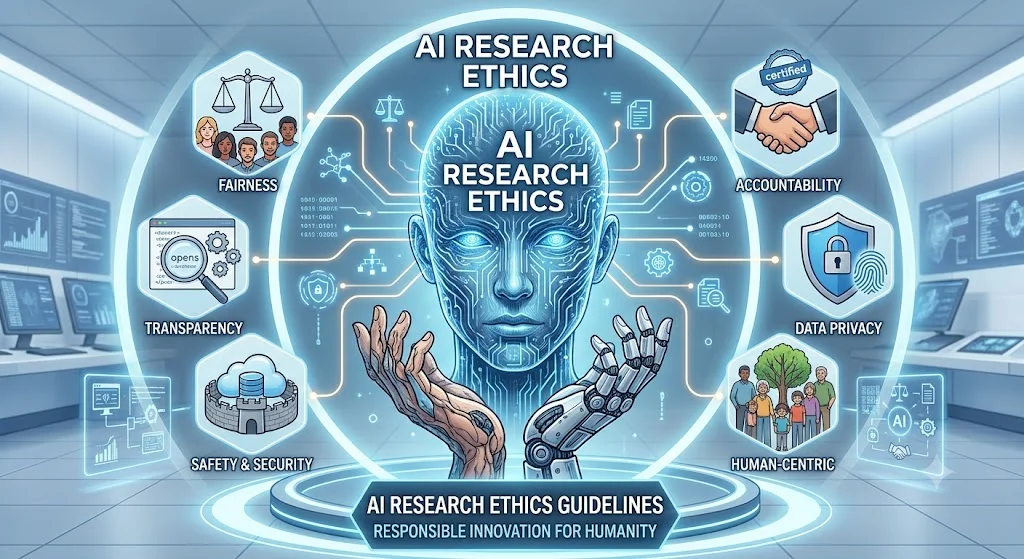
[ This image was created using generative AI ]
Papers Written by ChatGPT: Are They Really Mine? The AI Research Ethics Controversy
Why Must We Think About AI Research Ethics Right Now?
Have you recently tried using AI tools like ChatGPT or Claude to write something? We are living in an era where AI can effortlessly whip up everything from simple emails to complex coding, project proposals, and even the framework of academic thesis papers.
The reason I brought up this topic today is crystal clear: our ethical standards are struggling to keep pace with the sheer speed of technological advancement. When a deadline is looming tomorrow, and an AI hands you a beautifully written introduction, it is incredibly tempting to just copy and paste it. But can we proudly call that final product 'my research'? If we do not seriously ponder this issue right now, we risk collapsing the credibility of academia and halting genuine academic progress in the future. So today, as if we are having a friendly chat over a warm cup of tea, I want to break down this complex issue as simply as possible.
Is It Truly My Skill, or the AI's Creation?
When conducting research, the entire process of coming up with ideas, gathering data, and weaving them into logical writing can often feel painful. In those moments, generative AI feels like an oasis in the desert.
However, a dilemma arises here. If I type a few lines of questions and the AI generates three pages of excellent text, who owns the copyright to this writing? Is it me, the one who asked the question, or the AI that generated the sentences by learning from massive amounts of data?
The biggest issue lies in 'responsibility.' Academic papers and research reports are not just about good writing; they are documents where someone must take responsibility for the truthfulness of the content. Artificial intelligence does not take responsibility for what it writes. If an AI convincingly hallucinates false information and a researcher includes it without catching the error, the resulting academic and social damage falls entirely on human shoulders.
The Pros and Cons of AI in Academic Writing at a Glance
To help you understand better, I have put together a table summarizing the benefits and critical limitations of using AI in research.
Category | Positive Aspects (Benefits) | Negative Aspects (Limitations & Risks) |
|---|---|---|
Efficiency | Speeds up summarizing and translating vast amounts of literature. | Over-reliance can degrade the researcher's own critical thinking skills. |
Writing | Acts as a proofreading assistant for grammar and smooth sentence structure. | Leads to mechanical writing styles and a loss of creative, original expression. |
Reliability | Allows for brainstorming ideas from diverse perspectives. | Tends to confidently fabricate fake papers or non-existent data (Hallucination). |
Ethics | Breaks down language barriers (highly beneficial for non-English speakers). | High possibility of the output being a result of unauthorized training on others' work (Plagiarism debate). |
How Are Global Academia and Governments Responding?
So, how are renowned academic journals and institutions worldwide viewing this situation? Interestingly, they are not unconditionally rejecting artificial intelligence. They already know that completely blocking the tool is impossible.
World-class journals like Nature and Science have established very clear guidelines. The core principle is that "AI cannot be credited as an author." As I mentioned earlier, this is because AI cannot take responsibility. However, there is a growing trend to allow the use of AI for editing English grammar or organizing ideas. The strict condition is that researchers must transparently disclose which AI tool was used, at what stage of the research, and how it was utilized within the paper.
Major universities and academic circles are also publishing guidelines in a similar direction. They recommend acknowledging the use of AI tools to structure drafts as a way to enhance research efficiency, but they emphasize that the final writing and fact-checking must be performed directly by human researchers, and this process must be clearly stated. It does not mean you should avoid using it, but rather you should use it transparently and smartly.
3 Tips for Using AI Smartly and Ethically
So, how should we handle this powerful tool? If you keep these three principles in mind, you can safely conduct your research without getting swept up in ethical controversies.
Disclose Transparently: Honestly state the fact that you used AI in the introduction or the acknowledgment section of your paper. Simply stating, "This study received assistance from ChatGPT during the data translation process," can help you avoid a significant portion of ethical disputes.
Use Only as an Editor and Brainstorming Partner: Do not ask the AI to write from a blank slate. Instead, ask it to polish a rough draft you wrote yourself, or use it as a sparring partner to break through a creative block. The soul of the writing must come from your own mind.
Thorough Fact-Checking is Mandatory: Always doubt the statistics, dates, and references provided by AI. It is incredibly common for AI to make up papers that do not exist. You must develop the habit of tracking down and verifying the original sources yourself, even if it feels tedious.
Wrapping Up: A Tool is Just a Tool, Responsibility Belongs to Humans
It is time to wrap up our chat. Just as the invention of the calculator did not make the study of mathematics disappear, the era of ChatGPT writing papers does not diminish the value of human research. In fact, we could say this is a time when uniquely human critical thinking skills—weaving vast amounts of information together to offer new insights—will shine brighter than ever.
Ultimately, the choice is ours. Will we hide behind AI-generated text and lose our true skills, or will we use this smart assistant to elevate the quality of our research to the next level? I hope you become an amazing researcher who masters the tools rather than being dragged around by them.