Beyond Pixel Generation: Code-Based Rendering with OpenDesign Motion
OpenDesign Motion introduces a code-based approach to AI motion graphics. Instead of directly generating video frames, AI creates editable animation code that can be rendered into video. Discover how this workflow differs from traditional generative AI, why it matters for designers and developers, and where it works best. From animated logos to data-driven content, code-based rendering offers a flexible way to create consistent, reusable motion graphics for global audiences.
Beyond Pixel Generation: Code-Based Rendering with OpenDesign Motion
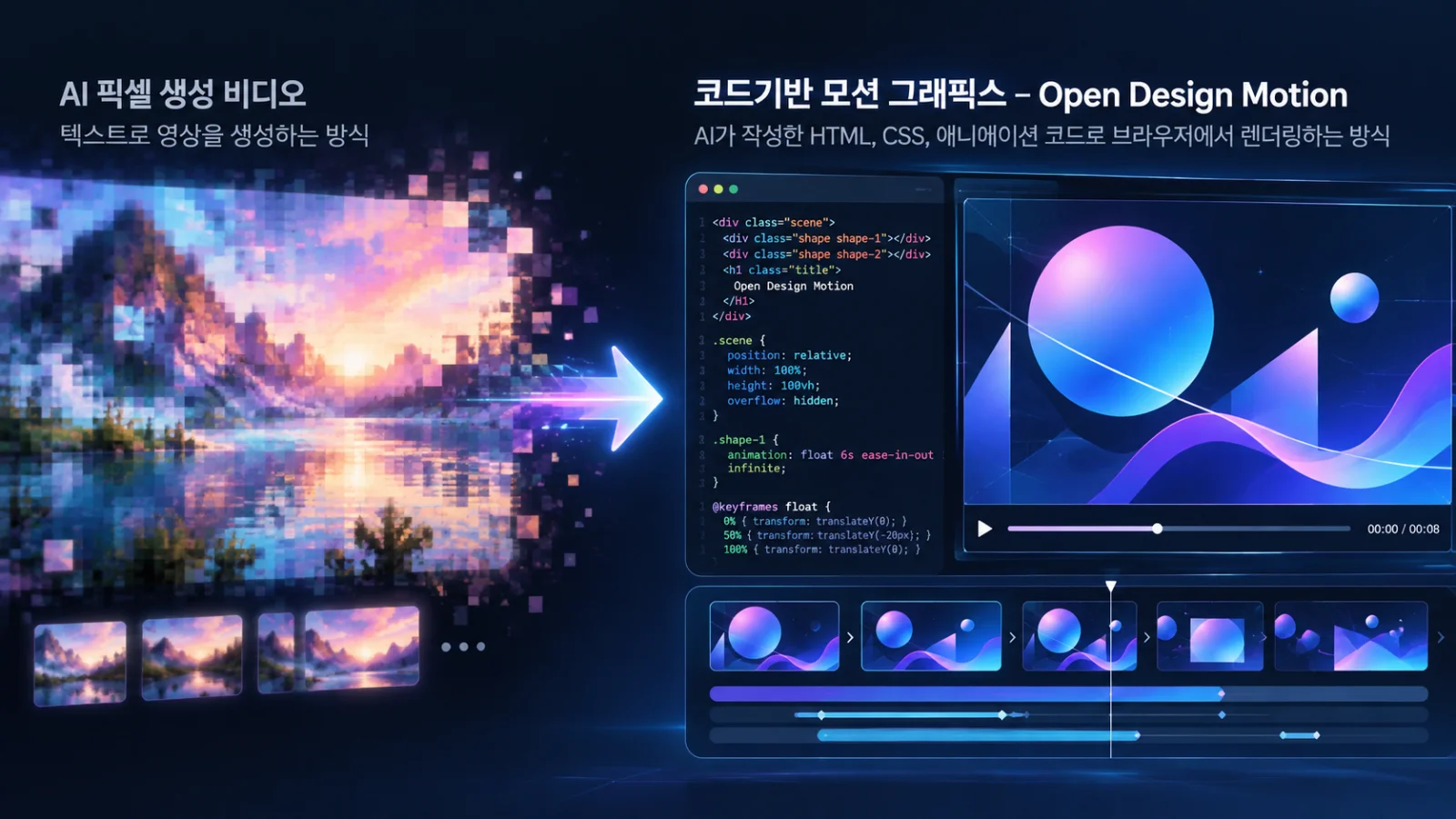
When people think about AI video generation, they usually imagine typing a prompt and watching an AI model create a video from scratch.
But another approach is gaining attention: instead of directly generating visual frames, AI writes code that defines how an animation looks and moves.
OpenDesign Motion introduces this approach through an open-source, code-driven motion design workflow.
What Is OpenDesign Motion?
OpenDesign Motion is a motion graphics capability within OpenDesign, an open-source AI design workspace.
Its Motion functionality was introduced with the OpenDesign 0.25.0 release in October 2026.
The idea is straightforward. Rather than relying entirely on AI-generated video frames, a coding agent creates structured animations using web technologies such as HTML, CSS, and JavaScript.
Imagine entering a prompt like:
"Create a five-second futuristic logo animation with glowing blue particles, smooth typography, and a cinematic ending."
The AI agent translates the request into animation code. A rendering workflow then turns the visual sequence into a playable video.
This approach gives creators more direct control over visual elements and animation behavior.
Pixel Generation vs. Code-Based Rendering
Traditional generative video systems use learned visual representations to produce moving images.
These models can create cinematic environments, realistic characters, and imaginative scenes.
Code-based rendering works differently.
Instead of predicting the appearance of every frame through a generative model, it describes visual objects and their behavior through executable instructions.
For example, a designer can define the position of a circle, its color, its movement speed, and how its opacity changes over time.
A rendering engine interprets those instructions and produces the final frames.
It is important to understand that code-based rendering still produces pixels. The difference is how the visual information is created.
In this workflow, AI primarily generates instructions for rendering rather than directly synthesizing the entire image sequence.
How Does the Workflow Operate?
The process typically begins with a natural-language instruction.
An AI coding agent interprets the creative request and constructs the necessary animation elements.
HTML provides the structure, CSS controls visual styling, and JavaScript-based animation tools can define more complex motion.
The resulting composition is rendered into frames and can then be exported as a video file.
Because the source code remains editable, creators can change text, colors, durations, transitions, and other properties without regenerating the entire design from scratch.
This repeatability is especially useful for content that requires frequent updates.
Why Does It Matter for Global Creators?
Around the world, brands, startups, educators, and independent creators increasingly need short-form visual content.
OpenDesign Motion can be useful for several applications:
Animated logos and brand introductions
Product announcements and promotional clips
Social media title animations
Data visualizations and motion infographics
Website demonstrations and interface animations
Consider a global company publishing promotional videos in several languages.
With a code-driven workflow, it may be possible to reuse the same animation structure while changing localized text, pricing, and branding.
This could simplify content production across regions.
For developers, another advantage is the ability to manage animation source files alongside other project code.
Can It Replace Generative AI Video?
Not entirely.
Code-based motion graphics are particularly effective when animations contain structured elements such as text, shapes, charts, and interface components.
However, realistic human movement, complex natural environments, and cinematic storytelling may still benefit more from dedicated generative video models.
There are also practical limitations.
AI-generated animation code may require debugging, layout adjustments, and additional rendering checks.
Although OpenDesign is open source, third-party AI models, APIs, and computing resources may introduce separate costs.
The best choice depends on the type of content being produced.
A Different Future for AI Motion Design
OpenDesign Motion represents an interesting shift in AI-assisted content creation.
Instead of treating a generated video as a fixed output, creators can work with an editable system of visual components, timing rules, and reusable animations.
This creates opportunities for automation, brand consistency, localization, and collaborative development.
Generative video models and code-based rendering systems do not necessarily compete. They address different creative requirements and may eventually become complementary parts of the same workflow.
The future of AI video production may not be defined by a single technology.
It may depend on how effectively creators combine visual generation, programming, and design control to produce the results they need.