CSK 2026: Naver Cloud CEO Kim Yu-won's Keynote Address
Kim Yu-won, CEO of Naver Cloud, emphasized at CSK 2026 that cooperation and solidarity among companies, governments, and countries are essential to address increasingly sophisticated cyber threats accelerated by AI.
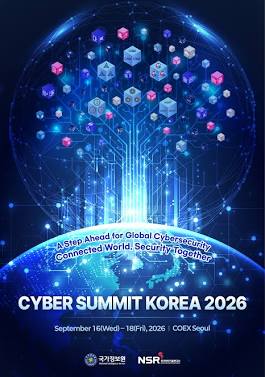
Cyber Summit Korea (CSK) 2026. (Source: CSK 2026 Cyber Summit Korea website)
CSK 2026: Naver Cloud CEO Kim Yu-won's Keynote Address
Cybersecurity in the AI era: 'solidarity' now matters more than ever
At Cyber Summit Korea 2026 (CSK 2026), held at COEX Seoul on September 17, 2026, Naver Cloud CEO Kim Yu-won delivered the event's first keynote address.
CSK 2026 is an international cybersecurity event hosted by the National Intelligence Service and the National Security Research Institute, held from September 16 to 18, 2026. This year's core message was "Connected World, Security Together" — security built together in a connected world.
The official program listed the title of CEO Kim's keynote as "Beyond Borders: Building Trust in a Connected World".
What stands out about this address is that it focused less on explaining AI technology itself and more on how cybersecurity should be viewed and addressed in the AI era.
1. Why did 'solidarity' become such an important theme at CSK 2026?
The advance of AI is bringing major changes to cybersecurity as well.
In the past, a cyberattack often required the attacker to personally gather information, find vulnerabilities, and prepare attack tools.
But as generative AI and AI agent technology advance, the potential to automate parts of that attack process is growing.
Yonhap News reported that in her CSK 2026 keynote, CEO Kim cited deepfakes, increasingly sophisticated phishing, AI-generated malware, and AI agents that find and exploit vulnerabilities as examples of new cyber threats.
Her core concern was that in this environment, it's becoming difficult for any single company or country to defend against every attack on its own.
So the key concept that came up repeatedly throughout this keynote was 'solidarity.'
The approach she described involves companies, governments, specialized security firms, research institutions, and countries sharing information and training together, so each can make up for the others' gaps.
2. 'Yesterday's competitors, today's security allies'
Newsis's coverage of CEO Kim's keynote highlighted, in particular, the message that even organizations that compete with one another need to cooperate on cybersecurity.
In the digital environment, companies' services and systems are all interconnected.
For example, a single large corporation investing heavily in security doesn't make the entire supply chain safe.
If a security problem occurs at a partner company or small business connected to a large corporation's systems, the risk can spread to other connected systems.
CEO Kim cited industries closely tied to national competitiveness — semiconductors, finance, telecommunications, defense, and aerospace — explaining that a security framework is needed that protects not just large corporations but the small and medium-sized businesses connected to the supply chain as well.
In other words, the perspective on cybersecurity needs to expand from defending individual companies to defending the entire ecosystem.
3. Is 'human speed' alone enough to counter AI-driven attacks?
Another point worth noting about security in the AI era is the change in attack speed.
Because AI can analyze large volumes of information quickly, using it in cyberattacks can speed up both attack preparation and automation.
According to Yonhap News, CEO Kim emphasized that while it used to take a considerable amount of time to go from discovering a vulnerability to launching an attack, AI's use in vulnerability discovery and generating attack methods can dramatically shorten that timeframe.
In this environment, the traditional approach of security staff reviewing every event one by one before responding can start to hit its limits.
So going forward, rather than using AI only for attacks, a structure that actively puts AI to work for defense as well may become important.
4. CEO Kim's emphasis: a 'security-specialized AI foundation model'
One thing that drew particular attention in this keynote was the cybersecurity-specialized AI foundation model.
A general-purpose AI model learns information across many fields, but cybersecurity requires knowledge and response methods that vary depending on each country's and industry's environment.
For example, a security issue in the semiconductor industry can't be judged the same way as one in the financial industry.
Building a security AI that can actually be used in the field also requires properly understanding Korea's industrial structure, laws and institutions, and information and communications environment.
Against this backdrop, CEO Kim explained the need for a security-specialized AI foundation model trained on Korea's security environment and real-world industrial context.
5. Security-specialized AI isn't just another corporate product
Another point CEO Kim emphasized is that she doesn't see security-specialized AI as a product meant for a single company alone.
According to coverage by Newsis and Byline Network, CEO Kim framed the security-specialized foundation model as infrastructure connected to national-level security capability.
Put simply, it looks like this.
The typical approach
AI model → a company's security product → defense for that one company
The direction CEO Kim described
Security data, AI technology, field experience
↓
Security-specialized AI model
↓
Used by a range of organizations — government, companies, research institutions
↓
Strengthened cybersecurity capability for the country as a whole
The key point is not to stop at building a single AI model, but to build an ecosystem connecting AI with specialized security firms, research institutions, and real-world industry.
6. Why is 'AI that understands the industrial field' necessary?
Simply detecting a cyberattack is a different problem from judging how that attack actually affects a given industry.
For example, the same security event can carry a different meaning depending on whether it happens in a financial system, a manufacturing system, or a telecom network.
CEO Kim cited industries where security is closely tied to national competitiveness — semiconductors, finance, science and technology, telecommunications, defense, and aerospace — explaining that security AI needs to understand the on-the-ground context of each industry.
Ultimately, this suggests that future security AI needs to evolve beyond simply saying
"An attack has occurred,"
toward judging
"which system this attack hit, what impact it could have on that industry, and what response is needed."
7. Security AI built together by government, companies, and research institutions
One important element in a security-specialized AI project is the collaborative structure behind it.
Developing security AI takes more than just AI technology.
Security data, security expertise, real-world industry experience, AI infrastructure, and R&D capability are all needed together.
CEO Kim explained that Naver Cloud can play the role of connecting these various capabilities into a single platform and ecosystem.
Structured out, it looks like this.
AI companies
→ AI models and technology
Security companies
→ threat intelligence and security expertise
Research institutions
→ R&D and specialized knowledge
Government
→ policy, institutions, and national-level support
The industrial field
→ real security problems and a validation environment
The idea is that connecting these elements together makes it possible to build a security AI ecosystem that can actually be used in the field.
8. Expanding into international cybersecurity cooperation
In this keynote, the concept of 'solidarity' wasn't limited to domestic cooperation alone.
Because AI-driven cyberattacks can easily cross borders over the internet, the argument was made that defense, too, requires cooperation between countries.
CEO Kim cited the international cyber defense exercise Locked Shields as an example, explaining the importance of multiple countries and organizations training together and building up their response capabilities.
It was also noted that Naver Cloud has taken part in international cyber defense exercises alongside national agencies and domestic security companies.
What these examples show is that cybersecurity can no longer be viewed as purely an internal security matter for a single organization.
9. From Korea to global security AI
CEO Kim also presented a direction for expanding the security-specialized AI model into the global market, rather than using it only domestically.
In particular, she described a vision connected to Naver Cloud's global AI infrastructure strategy, in which security AI would operate alongside AI infrastructure in each region, serving as a hub for cybersecurity cooperation.
Naver Cloud had previously announced plans to pursue building a global AI factory together with NVIDIA. According to materials from Naver, CEO Kim presented the related vision at the NVIDIA Cloud Partner Summit in June 2026.
So the vision for globally expanding security AI discussed at CSK 2026 can also be understood in connection with the AI infrastructure strategy Naver Cloud has been pursuing.
10. The shift in AI security shown by this keynote
CEO Kim Yu-won's CSK 2026 keynote can be broken down into a few important themes.
① An era where AI becomes an attack tool
As generative AI and AI agents advance, the potential for more automated and more sophisticated cyberattacks is growing.
② AI is needed for defense too
In an environment where attacks are getting faster, it's becoming important for the defending side to use AI as well to analyze and respond to threats.
③ The limits of a company defending alone
Because corporate systems are connected through supply chains, the cloud, and external services, no single company's security can protect the entire ecosystem on its own.
④ Industry-specific security AI
Security AI is needed that understands the specific environment of each industry — semiconductors, finance, telecommunications, defense, aerospace, and more.
⑤ Cooperation between nations
As cyberattacks easily cross borders, international information sharing and joint training are becoming more important as well.
11. Why this matters for everyday users too
CEO Kim's keynote focused on cybersecurity at the national and corporate level, but there are parts that connect to everyday users as well.
The smartphones, PCs, cloud services, online shopping, and financial services we use are all interconnected.
A security problem in one service can affect other services and users too.
In particular, as more people use generative AI, it's becoming important to understand the risks of AI-driven phishing, impersonation, and automated attacks.
So security in the AI era shouldn't be seen as a problem only for security experts, but as a basic digital-safety issue that everyone who uses AI needs to understand.
12. Key facts from CEO Kim Yu-won's CSK 2026 keynote
Key topic | Details |
|---|---|
Event | Cyber Summit Korea 2026 |
Date | September 17, 2026 |
Location | COEX, Seoul |
Speaker | Kim Yu-won, CEO of Naver Cloud |
Official keynote title | Beyond Borders: Building Trust in a Connected World |
Key keywords | AI security, solidarity, security-specialized AI, sovereign AI, international cooperation |
Main audience | Government, businesses, security companies, research institutions, the international community |
Industry perspective | Semiconductors, finance, telecommunications, defense, aerospace, and more |
Main direction | Strengthening domestic security capability and global cybersecurity cooperation |
CSK's official program also confirms that CEO Kim delivered the first keynote on the morning of September 17.
Conclusion
The core message CEO Kim Yu-won of Naver Cloud delivered at CSK 2026 can be summarized as: cybersecurity in the AI era depends on connection and cooperation.
As AI's potential to speed up and automate cyberattacks grows, security too needs to actively put AI technology to use.
In particular, this keynote pointed toward something beyond simply building AI security products — toward creating security-specialized AI that understands Korea's industry and security environment, and an ecosystem where government, companies, research institutions, and the international community all put it to use together.
Going forward, cybersecurity competitiveness is unlikely to be determined solely by how powerful any one company's security system is.
A structure that connects AI companies' technical capability, security firms' expertise, research institutions' R&D capacity, government policy and support, and real-world industry experience may become even more important.
CSK 2026's keynote can be seen as an example that framed this shift through the lens of 'cybersecurity that builds trust beyond borders.'
As AI advances rapidly, cybersecurity too is becoming, no longer a problem for a single organization, but a connected problem that has to be addressed together.
Please refer to the Cyber Summit Korea (CSK) 2026 website (https://cybersummit.kr)