How Job Seekers Should Use AI in 2026: 7 Practical Prompts for Resumes, Interviews & Company Researchc
How Job Seekers Should Use AI in 2026: 7 Practical Prompts for Resumes, Interviews & Company Research
How Job Seekers Should Use AI in 2026: 7 Practical Prompts for Resumes, Interviews & Company Research

Short answer: How should job seekers use AI in 2026?
Don't let AI write your entire application. Use it to organize your experience, get feedback, and practice interviews, then rewrite the final version in your own words.
Good uses: organizing experiences, analyzing job postings, polishing sentences, mock interviews
Risky uses: full ghostwriting, inventing experience, pasting personal data
Cost: free plans are enough to start
Time: about 30 minutes a day for one week to get set up
① Why Gen Z job seekers feel anxious about AI
Applicants and employers both use AI.
A Korean Ministry of Employment and Labor survey (Nov 2025) found that 86 of 394 responding top-500 companies (about 22%) use AI tools in hiring.
A separate industry survey reported that over 80% of recruiters use AI for simple text tasks like job posts and candidate emails, while only about 15% fully trust AI for core candidate evaluation.
The figures differ because the samples differ. The takeaway is that AI use is growing fast, but final decisions still lean on humans.
"Will AI-written resumes get rejected?" Some companies run tools to detect AI-written cover letters, so the real question is how far to use AI, not whether to use it.
Employers increasingly value people who use AI well, according to 2026 hiring-trend coverage.
② Key concepts in plain language
Term | Simple explanation |
|---|---|
Generative AI | AI that creates text, images, or tables from your input (ChatGPT, Gemini, Claude, etc.) |
Prompt | The instruction you give the AI. Specific prompts get better results |
ATS | Applicant Tracking System. Software that sorts resumes by matching keywords from the job post |
Hallucination | When AI confidently makes things up. Always verify |
Korea's AI Basic Act | In force since Jan 22, 2026. It includes labeling duties for generative AI outputs, aimed mainly at AI providers |
③ Five common mistakes
Typing only "write my cover letter" and getting a generic result.
Submitting AI-invented experience, which collapses under follow-up interview questions.
Pasting personal data (ID numbers, address, phone, student ID, full name).
Trusting AI's company facts without checking.
Copy-pasting the same letter to every company.
④ The realistic approach: AI is the coach, you are the star
Give AI your raw material (your experience) and ask for structure and feedback.
You own the facts. AI helps with organizing, questioning, and practice.
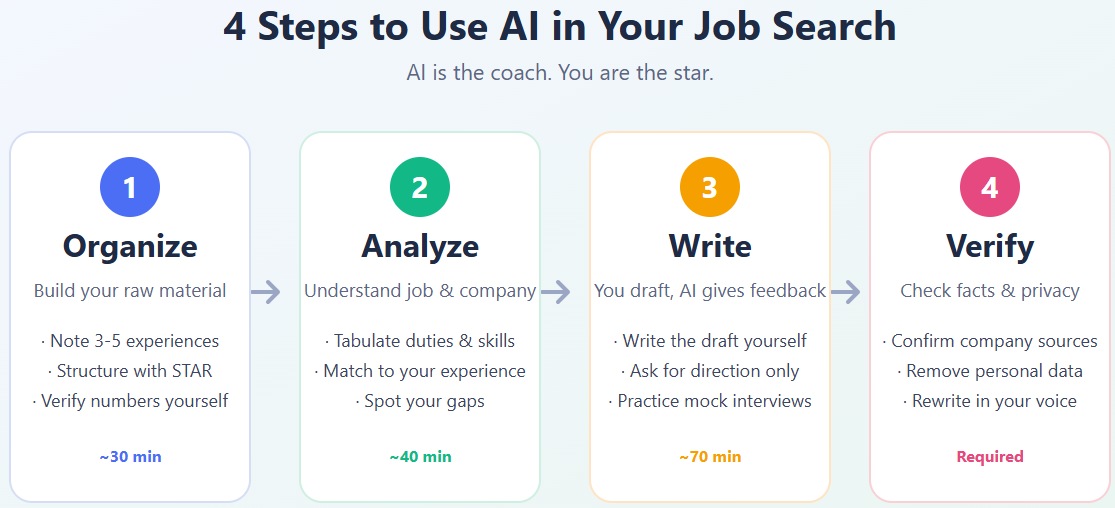
⑤ Step-by-step guide (with 7 prompts)
STEP 1. Build your experience notes (30 min)
Write 3-5 experiences roughly: situation, what you did, result (numbers), what you learned.
Prompt 1: Organize experience
Below are my rough notes. Restructure them using STAR (Situation, Task, Action, Result). Don't invent numbers. Ask me 5 questions about details I should verify.
[paste notes]
STEP 2. Analyze the job posting (20 min)
Prompt 2: Posting analysis
From the job posting below, make a table of (1) top 3 responsibilities (2) 5 required skills (3) preferred qualifications (4) keywords to emphasize. Don't guess anything not in the posting.
[paste posting]
STEP 3. Match your experience to the role (20 min)
Prompt 3: Matching
Compare the posting analysis with my experience list. Show which experience fits which skill. Be honest about gaps and suggest how to fill them.
STEP 4. Write the draft yourself, then get feedback (40 min)
Prompt 4: Feedback only
Here is my own draft. Don't rewrite it. Point out (1) vague parts (2) repetition (3) weak links to the role, and suggest directions for revision only.
[your draft]
STEP 5. Practice interviewing (30 min)
Prompt 5: Mock interview
You are an interviewer for an entry-level [role]. Based on my resume, ask one question at a time. After each answer, give (1) what was good (2) what to improve (3) one follow-up question. Five questions total.
STEP 6. Company research summary (20 min)
Prompt 6: Research
Summarize [company]'s recent business direction and news. Include source links, and mark anything unverified as "unconfirmed".
STEP 7. Final verification (required)
Prompt 7: Fact-check list
From the text below, list only the sentences that need fact-checking (numbers, company facts, dates).
Then check each item against official sources yourself.
⑥ Real-world example (fictional)
This is a fictional example for illustration only.
Minji (26, business major, applying for marketing)
Problem: She ran a club's social media but could only write "I worked hard."
AI use: With Prompt 1, AI asked, "What was the follower growth? Which content performed best?"
Result: She checked her real analytics, added the numbers, and rewrote the draft herself. Then she used Prompt 4 for feedback.
Interview: She ran Prompt 5 five times to prepare for questions like "How would you run our brand differently?"
Key point: This doesn't promise a pass. What changed was the specificity and confidence of her answers.
⑦ Cost, time, difficulty
Item | Details |
|---|---|
Cost | Major AI services (ChatGPT, Gemini, Claude, etc.) offer free plans. Paid plans are typically around US$20/month, but this varies. Check official pricing. Student offers change often, so read the current terms. |
Time | About 2 hours for initial setup, then 1-2 hours per application |
Difficulty | ★★☆☆☆ (copy-paste prompts to start) |
⑧ Cautions
Privacy: Remove your name, contact info, ID numbers, address, and student ID before pasting (e.g., "Hong Gildong" → "A").
Fact-check: Verify company info and statistics on official sites and news.
No ghostwriting: Submitting unedited AI output or copied text can lead to plagiarism or false-statement problems.
Check company rules: Some employers ask about or restrict AI use. Read the application guidelines.
Don't write what you can't explain in an interview.
⑨ Do-it-today checklist
Sign up for one free AI tool
Write 3 experience notes (situation-action-result-lesson)
Analyze one job posting with Prompt 2
Write the first draft yourself
Get feedback with Prompt 4
Do a 5-question mock interview with Prompt 5
Re-check company facts on the official website
Confirm you removed personal information
Read the final version aloud and edit it into your own voice
⑩ Key takeaways
AI is a coach, not a ghostwriter.
You provide the experience; AI provides structure and feedback.
Be specific in prompts: give a role, materials, a format, and "don't make things up."
Remove personal data and verify facts.
Today's task: write 3 experience notes.
FAQ
Q. Is it okay to use AI for my cover letter?
A. Rules vary by company. Read the guidelines, and use AI for idea organization and feedback to stay safe.
Q. Which AI is best?
A. Strengths differ and change often. Compare 2-3 free plans yourself.
Q. Are free plans enough?
A. For feedback and interview practice, usually yes.
References (checked August 2026)
Hankyung Job&Joy: 2026 hiring trends (Korean)
Greeting Blog: Recruitment Procedure Act and AI hiring (Korean)
Korea Policy Briefing: AI Basic Act (Korean)
This article is for information only and does not recommend any service or financial product. The people in the examples are fictional.
Image credit example: Photo by [photographer] on [Unsplash/Pexels]