Solid-State Batteries Explained: Why They're the Future of EV Batteries (and When They'll Actually Arrive)
A fact-checked look at solid-state batteries: what they are, why automakers are racing toward them, and how close commercialization really is.
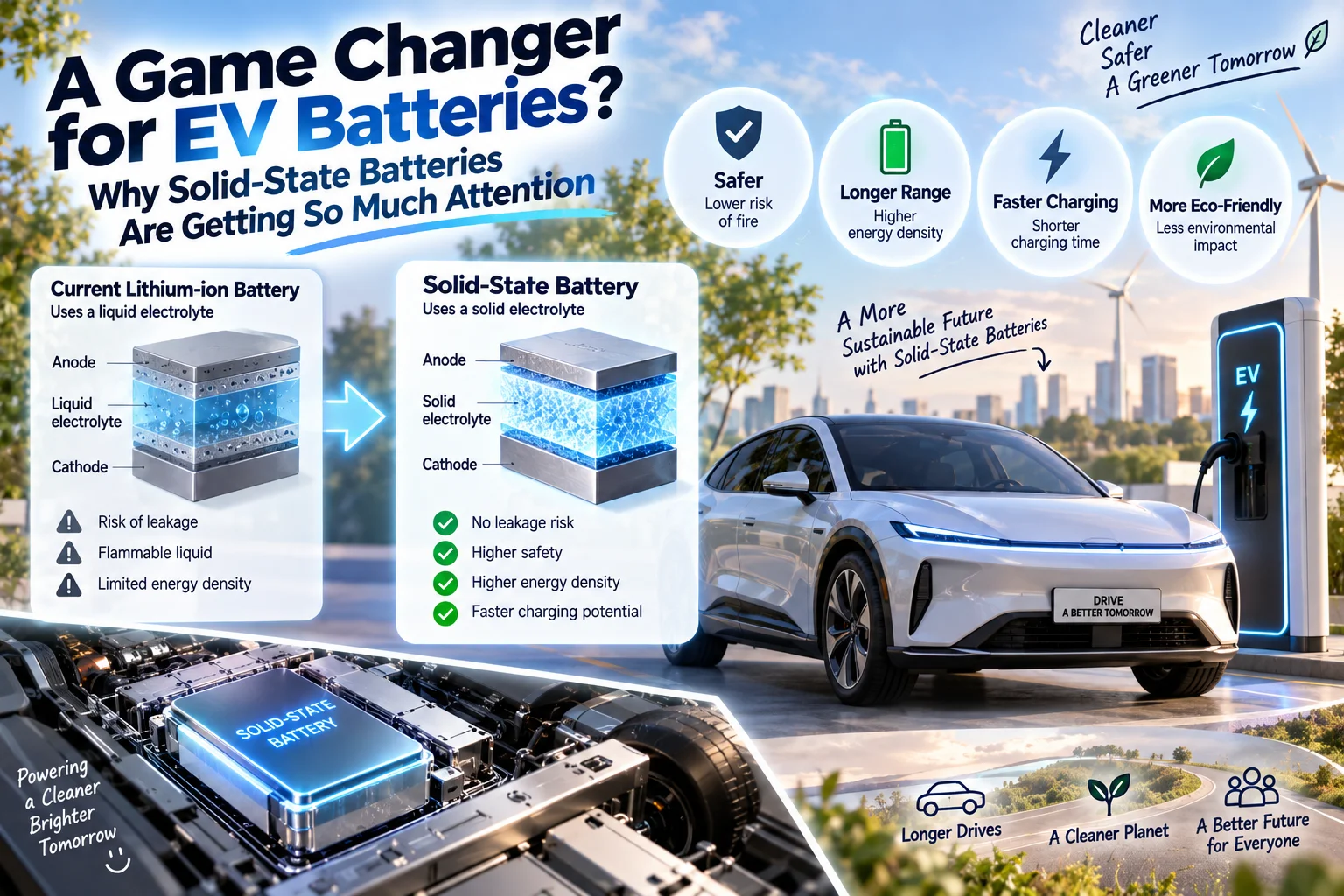
[ This image was created using generative AI ]
All-solid-state batteries could improve electric-vehicle range, charging performance, and safety. But 2027–2028 represents commercialization or production targets announced by certain companies, not a promise that every EV will use the technology or become cheaper by then. Here is what changes, what remains uncertain, and when drivers might see it on the road.
Key takeaways
All-solid-state batteries replace the conventional liquid electrolyte with a solid electrolyte that carries lithium ions.
They may reduce risks associated with flammable liquid electrolytes, but they are not completely fireproof.
Higher energy density and faster charging are potential benefits, not guaranteed specifications across all designs.
Toyota targets commercialization around 2027–2028; Nissan aims for an EV in fiscal 2028. Samsung SDI targets production in the second half of 2027, potentially beginning with robotics.
How are solid-state batteries different from lithium-ion batteries?
Conventional lithium-ion EV cells typically use a liquid electrolyte to help ions move between electrodes. An all-solid-state cell uses a solid material instead. That change affects cell design and may enable different electrode materials, but it also introduces new manufacturing challenges.
Feature | Conventional lithium-ion | All-solid-state |
|---|---|---|
Electrolyte | Typically liquid | Solid |
Market readiness | Widely used in EVs | Development, validation, early commercialization |
Potential strengths | Mature cost and supply chains | Better safety, density, charging potential |
Key challenges | Heat management, charging performance | Interfaces, durability, mass-production cost |
Why could range increase and charging become faster?
Some solid-state designs could accommodate higher-capacity electrodes and store more energy in a limited space. Certain solid electrolytes may also support efficient ion transport and high power. Yet vehicle range also depends on weight, aerodynamics, drivetrain efficiency, and weather—not battery chemistry alone.
A fast-charging result measured under controlled conditions does not mean every vehicle will match it. Real-world charging depends on charger power, battery temperature, and state of charge. Treat manufacturer performance targets as targets until production vehicles are independently tested.
Does solid-state mean zero fire risk?
Removing a flammable liquid electrolyte can reduce certain leakage and ignition hazards. However, a battery still stores significant energy, and internal short circuits, mechanical damage, and material reactions remain possible. Safer does not mean incapable of catching fire.
When will solid-state batteries be commercialized?
Toyota has stated a goal of commercializing all-solid-state batteries in 2027–2028 while developing products and production methods. Nissan aims to launch an EV with its in-house all-solid-state batteries in fiscal year 2028. A fiscal-year target should not be read as a January 2028 launch date.
Samsung SDI has announced a mass-production target for the second half of 2027, while indicating that humanoid robots could be an early commercial use. Battery production and the start of sales of an EV equipped with that battery are separate milestones. Testing, customer qualification, and factory yields may affect these schedules.
What is preventing widespread adoption?
The electrolyte must maintain effective contact with the electrodes. Small gaps can restrict ion movement, while repeated expansion and contraction during cycling may harm durability. Manufacturers must control these issues while consistently producing large numbers of cells.
New equipment, material costs, and manufacturing yields also influence pricing. Early deployments could therefore be limited to select models or premium applications. Meanwhile, conventional lithium-ion technology continues to improve, so the switch will not happen overnight.
Should you wait before buying an electric car?
If you need a vehicle soon, compare EVs that are actually available today: measured range, local charging access, warranty, and total price. If you can afford to wait, look for confirmed vehicle launch announcements and independent tests rather than battery-lab claims alone.
Your next step is to check the official specifications and battery warranty for an EV model you are considering. That gives you a practical benchmark against which future solid-state announcements can be judged.