CSK 2026 [Conference] Cyber Training Transformed: The K-Cyber Training Center!
At CSK 2026, experts discuss the center’s vision, international cyber-training models, and ways to strengthen cross-border cooperation and collective responses to evolving cyber threats.
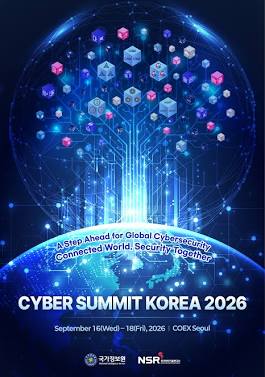
Cyber Summit Korea (CSK) 2026. (Source: CSK 2026 Cyber Summit Korea website)
CSK 2026 Session C-2, “Cyber Training Transformed: The K-Cyber Training Center!”
As cyber threats become increasingly sophisticated, cybersecurity education and training methods are also evolving. Beyond simply mastering specific attack techniques, there is a growing emphasis on training that allows participants to experience diverse crisis scenarios in realistic environments, enhancing cooperation between nations and organizations.
A session showcasing this trend was held at Cyber Summit Korea (CSK) 2026: Session C-2, 'Cyber Training Transformed... K-Cyber Training Center!'.
According to the official CSK 2026 program, this session took place on September 17 from 15:30 to 17:00, chaired by Tony Sarr, Director of the NATO CCDCOE. The session examined the operational status of cyber training centers in various countries and discussed mutual cooperation,while also presenting the 'K-Cyber Training Center Vision.'
Why Is the K-Cyber Training Center Being Established?
The K-Cyber Training Center is an initiative driven by the National Intelligence Service (NIS) to build dedicated infrastructure capable of conducting international cyber education and training.
In July 2024, the NIS revealed its plan to construct a dedicated international-scale cybersecurity education and training infrastructure. According to the plan, the K-Cyber Training Center, with a total floor area of about 10,000㎡, will be built in Daejeonto feature facilities for training against cyber threats targeting next-generation technologies like AI and autonomous driving, along with cybersecurity lecture rooms and international training grounds.
Crucially, unlike conventional educational facilities, its defining feature is providing a space dedicated to international cyber training exercises.
The NIS explained that once the facility is completed, up to 400 people will be able to train simultaneously and over 3,000 experts can be educated annually.
How Does It Differ from a Simple 'Cyber Training Center'?
When thinking of cybersecurity education, one typically imagines learning security theories in a classroom or practicing specific technical skills.
However, responding to nation-state level cyber threats requires a different type of training.
For instance, during an actual cyber crisis, multiple organizations—such as government agencies, private enterprises, and security firms—must respond simultaneously rather than in isolation.
Therefore, training must offer practical experience in scenarios such as:
• Simulating environments realistic to actual cyber crises
• Response exercises involving multiple organizations simultaneously
• Responding to cyber threats arising from emerging technologies
• Training across post-attack detection, analysis, and response workflows
• Information sharing and collaboration between agencies and nations
• Joint responses to international cyber crisis situations
The significance of the K-Cyber Training Center lies in its plan to serve as a foundational facility for conducting such international-scale education and training.
Why AI and Autonomous Driving Are Included in the Training Scope
One key feature of the K-Cyber Training Center is that it includes cyber training arenas targeting next-generation technologies like AI and autonomous driving.
In the past, cybersecurity focused primarily on protecting traditional IT environments like computers, networks, and servers.
However, as AI expands into various industries and technologies like autonomous driving advance, the surface needing protection is expanding.
This is because new security vulnerabilities can emerge not only in AI systems themselves, but also in AI-powered services, data, and interconnected infrastructure.
Therefore, future cyber training needs to move beyond simple network attack responses and evolve toward addressing threats emerging in complex environments that incorporate new technologies like AI.
The NIS has also announced plans to build next-generation cyber training arenas covering AI and autonomous driving at the K-Cyber Training Center.
The K-Cyber Training Center and International Cooperation
Another crucial keyword regarding the K-Cyber Training Center is international cooperation.
Session C-2 at CSK 2026 was also structured not merely to introduce domestic cyber training facilities, but as a venue to discuss the operational status of training centers globally and strategies for mutual cooperation.
Cyberattacks do not respect national borders.
Attack infrastructure can be distributed across multiple countries, and a single cyberattack can simultaneously impact several nations and enterprises.
For this reason, along with enhancing individual national cybersecurity capabilities, boosting inter-state information sharing and joint response capabilities is equally important.
The K-Cyber Training Center has strong potential to serve as a training foundation for such international cooperation.
The Connection Between APEX and the K-Cyber Training Center
To understand the K-Cyber Training Center, it is also worth looking into APEX (Allied Power EXercise).
When announcing the K-Cyber Training Center plan in 2024, the NIS also revealed that South Korea would host APEX 2024, a Korea-led international cyber exercise, in September of that year.
According to plans at the time, cybersecurity experts from over 20 NATO and Indo-Pacific countries, including the U.S., Japan, and Singapore, were scheduled to participate.
In particular, unlike traditional competition-centric cyber exercises, APEX was introduced as a training program focused on crisis response through international information sharing and cooperation.
This experience with joint international exercises aligns directly with the direction of the K-Cyber Training Center, establishing the foundation to conduct future international-scale cyber drills.
Why the K-Cyber Training Center Was Featured at CSK 2026
CSK 2026 addressed a wide range of topics, including AI, international cybersecurity, and national cyber security policies.
Placing Session C-2 on the topic of cyber training highlights that alongside technological advancement, establishing a system to train cybersecurity personnel for real-world crisis response is becoming increasingly vital.
In particular, Session C-2 explored the following perspectives:
First, National Cyber Training Systems
Examining how different countries operate their cyber training facilities.
Second, Joint International Exercises
Because cyber crises are often difficult to resolve through a single nation's response alone, joint training and cooperation among countries are becoming increasingly vital.
Third, The Role of the K-Cyber Training Center
Establishing South Korea's foundation to conduct international cybersecurity education and training.
The official CSK program also highlighted as key components of this session the operational status of cyber training centers in various countries and mutual cooperation strategies, as well as the K-Cyber Training Center Vision.
Potential Impact of the K-Cyber Training Center
If the K-Cyber Training Center is built as planned and utilized for international exercises, it could transform the domestic cybersecurity education and training landscape.
1. Expanding the Scale of Cyber Training
With facilities capable of training up to 400 people simultaneously, the infrastructure will support large-scale exercises involving major organizations and institutions beyond basic small-group practice.
2. Training Focused on Next-Generation Technologies
It is designed to conduct cyber training tailored to emerging technological environments such as AI and autonomous driving.
This provides an ideal environment to prepare for novel types of cyber threats that will emerge in the future.
3. Potential to Expand Joint International Exercises
Featuring international training arenas and convention-style halls, it has strong potential as a platform for joint exercises and training programs with overseas cybersecurity experts and organizations.
4. Expanding Cybersecurity Expert Education
The NIS anticipates the center will be capable of educating over 3,000 experts annually.
This is a critical milestone for expanding the workforce and enhancing overall cybersecurity capabilities.
How Will the Paradigm of 'Cyber Training' Shift?
The title of this CSK 2026 session, 'Cyber Training Transformed,' should not merely be seen as the launch of a new training facility, but rather through the lens of a rapidly shifting threat landscape.
While identifying vulnerabilities and detecting attacks were core elements of cyber training in the past, holistic response capabilities in complex scenarios will become essential in the future.
For instance, in AI-integrated environments, various elements—such as AI services, data, networks, and user accounts—are closely interconnected.
Consequently, when a security incident occurs, organizations must consider not only technical mitigation, but also inter-organizational communication, information sharing, situational assessment, recovery, and prevention.
Ultimately, future cyber training is likely to expand from learning 'techniques to defend against attacks' to 'training the capability to manage complex cyber crises'.
Expected International Cybersecurity Cooperation via the K-Cyber Training Center
The K-Cyber Training Center serves not only as a domestic training facility but also as a hub for international cybersecurity cooperation.
Along with establishing the center, the NIS outlined plans to strengthen cybersecurity cooperation with NATO and Indo-Pacific nations to enhance joint international response capabilities.
The fact that a NATO CCDCOE official chaired Session C-2 at CSK 2026 to discuss operational trends and international collaboration aligns directly with this global perspective.
Key Aspects to Watch Moving Forward
The K-Cyber Training Center is scheduled for completion in Daejeon by the end of 2027.
Moving forward, it will be important to observe whether construction progresses as planned, what training environments are established, and how domestic and foreign institutions participate.
In particular, key points of interest will include:
• Next-generation technology environments (AI, autonomous driving) applied in actual training
• Formats for joint cyber exercises between domestic and international organizations
• International cybersecurity educational programs
• Expansion of cooperation with NATO and Indo-Pacific nations
• Scale and curricula of training programs for domestic cybersecurity experts
• Training methodologies designed to enhance real-world cyber crisis response capabilities
Conclusion
CSK 2026 Session C-2, 'Cyber Training Transformed... K-Cyber Training Center!', highlights how the meaning of 'training' in cybersecurity is expanding.
Far beyond a standard educational facility, the K-Cyber Training Center is designed for cyber training encompassing next-generation technologies like AI and autonomous driving, large-scale expert education, and international joint exercises.
Additionally, at CSK 2026, the vision for the K-Cyber Training Center was presented alongside discussions on global training center operations and international cooperation strategies.
In an era of rapidly changing cyber threats, developing new security technologies is just as vital as establishing a system for repeated training so multiple organizations can respond jointly in real crises.
It will be worth watching what role the K-Cyber Training Center will play in nurturing domestic cybersecurity talent and advancing joint international exercises.
Please refer to the Cyber Summit Korea (CSK) 2026 website (https://cybersummit.kr)