CSK 2026 [Conference] International Cybersecurity Issues and Response Strategies
Key discussions covered high-performance AI threats, emerging technology security, software supply-chain security, post-quantum cryptography, and international cooperation for strengthening real-world cyber defense capabilities.
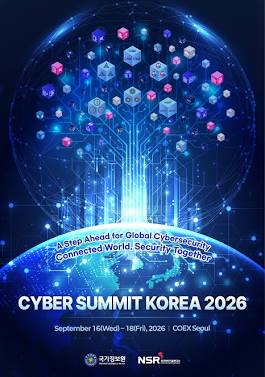
Cyber Summit Korea (CSK) 2026. (Source: CSK 2026 Cyber Summit Korea website)
CSK 2026 Session B-3: International Cybersecurity Issues and Response Strategies
From agentic AI to the WEF and EU's approaches to security threats
As artificial intelligence (AI) establishes itself as a new core technology in cybersecurity, the shape of cyber threats is changing rapidly too.
In particular, attention has recently turned to agentic AI, which goes beyond generative AI that simply answers questions, and instead searches for information, calls tools, and carries out multiple tasks on its own according to a user's instructions.
As AI gains more authority and access to systems, security concerns can expand beyond simply protecting the AI model to include infrastructure, data, accounts, APIs, the supply chain, and national security as well.
Held against this backdrop, Cyber Summit Korea 2026 (CSK 2026) featured a range of discussions covering international cybersecurity threats and response strategies.
CSK 2026 was jointly hosted by the National Intelligence Service and the National Security Research Institute, and held at COEX Seoul from September 16 to 18, 2026. The official event ran a variety of programs, including international information exchange, a conference, the international cyber exercise (APEX), the Cyber Conflict Exercise (CCE), and exhibition/promotional booths.
This article looks at three topics covered in Session B-3, "International Cybersecurity Issues and Response Strategies."
1. Three core topics covered in Session B-3
The presentation topics of Session B-3 were as follows.
① Agentic AI: Securing the underlying infrastructure
Speaker: Brent McConnell, CEO, Cornerstone Global (U.S.)
② WEF's strategy for responding to security threats
Speaker: Akshay Joshi, Head, WEF Centre for Cybersecurity
③ EU's strategy for responding to security threats
Speaker: David Song-Pehamberger, Deputy Director, EU Hybrid CoE
These three topics may look like they cover separate areas, but they share something in common.
That is, they all look at cybersecurity not as a problem of individual systems, but as something that plays out in an environment where nations, companies, and society as a whole are all connected.
2. First topic
Agentic AI: Securing the underlying infrastructure
An era in which AI acts on its own
Traditional generative AI has mainly been used in a way where the user enters a question and the AI generates an answer.
But agentic AI takes this a step further.
After understanding the user's goal, it becomes capable of more autonomous action — finding necessary information, calling external tools, analyzing data, and carrying out a defined task across multiple steps.
For example, consider a company assigning an AI agent a task like this.
"Analyze recent security events, classify the high-risk items, and write up a report for the person in charge."
To carry out this task, the AI agent might access security logs, query a database, or call the API of another security system.
This is exactly where the problem arises.
That's because AI being able to do more work at the same time means it needs more authority.
3. How agentic AI's security problem differs from that of existing AI
The security problem with agentic AI isn't limited to the AI simply generating a wrong answer.
If the AI is connected to real systems, a wrong judgment or a malicious input can lead to real-world action.
For example, consider risks like the following.
Executing an incorrect command
Using excessive system permissions
Accessing sensitive data
Being made to behave incorrectly by malicious data or a prompt
A connected API or tool being attacked
The AI agent's account or credentials being stolen
Difficulty tracing the scope of responsibility in an environment where multiple AI agents are connected
Guidance on agentic AI published by the Australian Cyber Security Centre in 2026 likewise emphasizes these characteristics.
The guidance explains that as agentic AI's potential use in critical infrastructure and defense grows, its autonomy, interconnectedness, and dependence on large language models can give rise to security and governance issues different from those of traditional software or general generative AI.
4. What matters most isn't 'the AI itself,' but 'the environment the AI connects to'
Protecting the AI model alone isn't enough to use agentic AI safely.
The entire environment the AI can access needs to be protected too.
For example, consider a structure like this.
User → AI agent → API → database → enterprise system
If even one part of this isn't properly protected, it can affect the security of the entire system.
So the following security elements become important in the agentic AI era.
Least privilege
AI agents should be given only the permissions needed for their required functions.
Giving an AI administrator-level access to every system can increase risk.
Strong authentication
When AI agents access systems, their identity needs to be verified and their credentials managed securely, just as with human accounts.
Continuous monitoring
It's necessary to continuously check which systems the AI accessed, what data it used, and what actions it carried out.
Human oversight
Rather than letting AI handle even important tasks fully automatically, it's also important to design high-risk tasks so that a human gives final confirmation.
Phased adoption
Instead of applying agentic AI to all critical operations from the start, it's necessary to apply it first to relatively lower-risk tasks, check the results, and then expand its scope.
Indeed, 2026 guidance published by international cybersecurity agencies also presents least privilege, continuous monitoring, strong identity management, human oversight, and integration with existing cybersecurity frameworks as important response elements.
5. Second topic
WEF's strategy for responding to security threats
The second presentation addressed a strategy for responding to security threats from the perspective of the World Economic Forum (WEF) Centre for Cybersecurity.
The speaker was Akshay Joshi, Head of the WEF Centre for Cybersecurity.
According to official WEF materials, as head of the WEF Centre for Cybersecurity, Akshay Joshi works to elevate cybersecurity as a strategic priority and to enable the public and private sectors to respond together to systemic cybersecurity issues.
Akshay Joshi is also confirmed to have taken part as head of the Centre for Cybersecurity in the WEF's Global Cybersecurity Outlook 2026.
6. Cybersecurity isn't a problem for companies alone
In the past, cybersecurity was often thought of mainly as a technical issue that a company's IT department needed to manage.
But as digital technology has become connected across all of society, the situation has changed.
That's because major functions of society — finance, healthcare, transportation, telecommunications, energy, manufacturing, and government services — now depend on networks and software.
So the potential for a single cyberattack to affect society as a whole, beyond just a specific company, is growing too.
For example, when a company's systems are attacked, it may not end with simply that company's operations being disrupted.
If the company is connected to its suppliers, customers, financial institutions, and logistics systems, the impact can spread to other organizations.
This is why, in international cybersecurity, the resilience of the entire interconnected ecosystem, not just the defensive capability of individual organizations, is becoming important.
7. Why the WEF emphasizes the importance of cooperation
International cyber threats are often difficult for a single country or a single company to solve alone.
Attackers can operate across borders, and a single attack campaign can target the systems of multiple countries and companies at the same time.
So it's important for governments, companies, security firms, international organizations, and research institutions to cooperate by sharing threat information and strengthening response capability.
CSK 2026 itself also puts forward this kind of international cooperation as a major direction.
The official event description emphasizes the meaning of cooperation — jointly responding to global cyber threats in a cyberspace that connects the world, and protecting cyberspace together across borders.
8. In the AI era, the speed of cyber threats changes too
Advances in AI don't only help the defending side.
The attacking side can make use of AI too.
That's because AI can be used to analyze information, find attack targets, or make social engineering messages more sophisticated.
There's also the possibility that if agentic AI is used to automate attacks, the speed and scale of attacks could change too.
Coverage related to CSK 2026 also emphasized that, as AI advances, cyberattacks using autonomous AI are emerging as a real security issue.
So in cybersecurity for the AI era, the question that matters is moving beyond simply "should we use AI," to
how to safely design the environment in which AI is used
.
9. Third topic
EU's strategy for responding to security threats
The third presentation addressed Europe's strategy for responding to security threats.
The speaker was David Song-Pehamberger, Deputy Director, EU Hybrid CoE.
David Song-Pehamberger is introduced as the person responsible for the strategy and defense area at the European Centre of Excellence for Countering Hybrid Threats (Hybrid CoE), specializing in the relationship between cyber and emerging technology and hybrid threats.
Rather than treating cyberattacks as a separate issue on their own, Hybrid CoE approaches security through the lens of hybrid threats — threats that combine multiple different means.
10. What is a hybrid threat?
A hybrid threat refers to a form of activity that doesn't rely on just one method of attack, but combines multiple means to exploit the vulnerabilities of a state or society.
For example, the following means can be combined with one another.
Cyberattacks
Disinformation and information manipulation
Causing social unrest
Attacks on critical infrastructure
Economic pressure
Exploiting technological dependence
Interference with physical facilities
Exerting influence by exploiting conflicts between states
In its 2026 materials on responding to hybrid threats, the European External Action Service (EEAS) describes not just cyberattacks, but multiple types of activity — foreign information manipulation and interference, damage to undersea cables, sabotage, and airspace violations — as examples of hybrid threats.
In other words, modern security threats aren't limited to simply attacking computer systems.
11. Cyberspace is an important arena for hybrid threats
This same perspective was presented at a symposium on cyber power that Hybrid CoE held in 2026.
David Song-Pehamberger of Hybrid CoE explained that cyberspace connects many areas of society, and plays an important role in the various hybrid-threat campaigns Europe faces.
He also explained that much malicious cyber activity occurs as part of hybrid campaigns in the so-called gray zone that precedes full-scale armed conflict.
From this perspective, cybersecurity can't simply be viewed as "the technology for blocking hacking."
Because cyberattacks can combine with political, economic, social, and military objectives, a strategic response system at the national level is necessary.
12. A notable part of the EU's response
One important concept in understanding the EU's response to hybrid threats is resilience.
Rather than aiming only to block 100% of attacks, this is about preparing so that society and organizations can maintain normal function and recover quickly even when an attack occurs.
For example, critical infrastructure needs preparation like the following.
Preparedness
Analyzing in advance what problems would arise if a given system were attacked.
Detection
Building a monitoring system that can quickly spot signs of anomalies.
Response
Deciding in advance how the responsible agency and companies will respond when an attack occurs.
Recovery
Preparing backup and recovery systems so core functions can be quickly restored even if a service is disrupted.
Cooperation
Building an information-sharing and joint-response system between nations, institutions, and companies.
13. Connecting the three presentations
Although the three presentations' topics are divided into AI, international cooperation, and EU security strategy, they're connected to one another.
Bringing them together into a single flow looks like this.
Growing autonomy of AI
↓
Growing number of systems and infrastructure AI can access
↓
Expanding potential for automation in cyberattack and defense
↓
Expanding from a company-level risk to a national and societal one
↓
Growing need for cooperation between states and international organizations
↓
The need for a combined cybersecurity + hybrid-threat response strategy
This can be seen as the important throughline for understanding CSK 2026's discussion of international cybersecurity.
14. Changes worth thinking about from a company's perspective
This international discussion also has direct relevance for ordinary companies.
In particular, for a company adopting AI into its operations, it doesn't end with simply providing AI services to employees.
Once AI starts connecting to a company's data and systems, the scope of security management expands along with it.
For example, the following questions need to be reviewed internally at a company.
What data can the AI access?
Giving AI access to all internal company data versus only the data needed for a task makes a difference from a security standpoint.
What systems can the AI run?
AI simply displaying information and AI actually executing commands on a real system carry different levels of risk.
Are the AI's actions being logged?
It needs to be possible to trace what data and systems the AI accessed, so the cause can be identified if a problem occurs.
What tasks require human involvement?
For high-impact tasks like financial transactions, changing system settings, or deleting important data, it's worth considering a process that requires human confirmation.
Is the AI supply chain secure?
Beyond the AI model itself, the various components the AI depends on — APIs, the cloud, open source, data, and external services — need to be managed together as well.
15. AI security ordinary users should know
AI security isn't a problem for companies or government agencies alone.
Individual users, too, need to keep the following basic precautions in mind when using generative AI.
First, it's best not to enter sensitive personal information as-is.
Care should be taken before entering things like a resident registration number, account information, passwords, or a company's confidential information into a public AI service.
Second, information generated by AI shouldn't be automatically accepted as fact.
Because AI can generate information that sounds plausible but is actually wrong, important information needs to be verified through a separate source.
Third, files or links provided by AI also require caution.
That's because in the AI era, malicious links or files could be delivered in combination with AI in ways that feel more natural.
Fourth, the permissions granted to an AI service need to be checked.
If an AI agent can access email, files, a calendar, or work systems, it's important to develop the habit of checking exactly what permissions have been allowed.
16. The shift in cybersecurity that CSK 2026 revealed
CSK 2026 covered a wide range of topics, including responding to AI threats, international cybersecurity strategy, software supply chain security, and post-quantum cryptography.
The event brought together delegations from overseas intelligence and security agencies, along with participants from government, industry, and academia. According to related coverage, delegations from 56 overseas intelligence and security agencies across 31 countries took part, and roughly 3,000 people attended the event.
One important shift confirmed through the three presentations of Session B-3 is that the scope of cybersecurity is expanding rapidly.
Where cybersecurity in the past focused on protecting computers and networks, it's now become a situation where AI, critical infrastructure, national security, the supply chain, international cooperation, and social resilience all need to be considered together.
17. How will cybersecurity change going forward?
As AI automates more tasks going forward, the authority granted to AI is likely to grow as well.
As a result, security itself is likely to shift in the following direction.
From security that uses AI
,
to security that safely operates AI itself
,
and then again
to security that protects the entire ecosystem AI is connected to
— its scope is expanding this way.
In particular, as agentic AI starts connecting to a company's work systems and critical infrastructure, "how much authority has AI been given" can become just as important a question as "how smart is the AI."
And at the national level, beyond protecting individual systems, a system capable of responding to multiple forms of hybrid threats — cyberattacks, information manipulation, threats to critical infrastructure, and more — may become necessary.
18. Conclusion
CSK 2026 Session B-3, "International Cybersecurity Issues and Response Strategies," was made up of topics that prompt reflection on how AI and the changing international security environment affect cybersecurity.
CEO Brent McConnell's "Agentic AI: Securing the Underlying Infrastructure" invites reflection on how to protect infrastructure and permissions in an environment where AI behaves ever more autonomously.
WEF Centre for Cybersecurity Head Akshay Joshi's "WEF's Strategy for Responding to Security Threats" shows a perspective that views cybersecurity not as a problem for individual companies, but as one requiring international cooperation.
EU Hybrid CoE Deputy Director David Song-Pehamberger's "EU's Strategy for Responding to Security Threats" makes it possible to examine the modern security environment through the lens of hybrid threats, in which cyberattacks can combine with information manipulation and threats to critical infrastructure.
In the end, the important question in cybersecurity for the AI era is moving away from simply
"should we use AI?"
and toward
"how do we make the environment AI is connected to safe?"
As AI takes on more work, the authority given to it and the systems it connects to can grow as well.
So cybersecurity going forward needs to advance not just by keeping pace with AI technology, but by developing permission management, continuous monitoring, human oversight, critical infrastructure protection, and international information sharing and cooperation together.
The international cybersecurity discussion covered at CSK 2026 is a case in point showing that this shift is no longer a story for the distant future, but a task already underway today.
Please refer to the Cyber Summit Korea (CSK) 2026 website (https://cybersummit.kr)