CSK 2026 [Conference] The Three Mega Projects and Cybersecurity
At CSK 2026, cybersecurity was highlighted as a fundamental requirement for the successful implementation of Korea's three major national mega-projects: semiconductors, physical AI, and AI data centers.
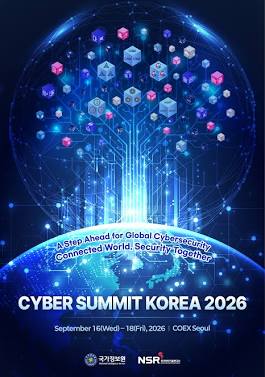
Cyber Summit Korea (CSK) 2026. (Source: CSK 2026 Cyber Summit Korea website)
CSK 2026 Session C-3: The Three Mega Projects and Cybersecurity
New cybersecurity for protecting AI data centers, physical AI, and advanced technology
As artificial intelligence (AI) spreads rapidly into a core area of industry and national infrastructure, the scope of cybersecurity is changing dramatically as well.
Where the key task of cybersecurity used to mainly be protecting computers, networks, and data stored on servers, it has now become an era where AI models and data, the judgments AI makes, and even the physical systems that act on AI's judgment all need to be protected.
One event that offered a look at this shift was Cyber Summit Korea 2026 (CSK 2026).
CSK 2026 was held at COEX Seoul from September 16 to 18, 2026, jointly hosted by the National Intelligence Service and the National Security Research Institute. The event covered the latest technology and policy surrounding cybersecurity, international cooperation, and security issues on the industrial front line.
Among the sessions that drew particular interest was "The Three Mega Projects and Cybersecurity."
This session looked at cybersecurity challenges around nationally driven large-scale technology projects, from three perspectives: AI data centers, physical AI, and protecting corporate advanced technology.
1. What is the core of Session C-3?
This session was chaired by Director Kim Tae-gyun (National Security Research Institute), with three thematic presentations centered on the latest cyber-threat trends.
Session structure
[Chair] Director Kim Tae-gyun (National Security Research Institute)
Thematic presentations
Building public AI data centers and a strategy for embedding security by design
Director Lee Chang-yeol (KEPCO KDN)
The direction cybersecurity is evolving in the age of physical AI
Researcher Yoon Jung-hyun (Institute for National Security Strategy)
The value and significance of corporate security in the age of technology hegemony
Professor Jang Hang-bae (Chung-Ang University)
The three presentations may look like they cover different fields, but they raise a shared question.
As AI and advanced technology become core infrastructure for nations and industries, how should security be designed?
In other words, an important lens for understanding this session is that security shouldn't be added after a technology is finished, but needs to be considered together starting from a project's planning and design stages.
2. A public AI data center isn't finished just by building the GPUs
The first presentation focused mainly on building public AI data centers and embedding security by design.
An AI data center is core infrastructure that supports AI model training and inference using large-scale GPUs, servers, networks, and storage.
In particular, when AI data centers are used in the public sector, security requirements can arise that differ from those of an ordinary corporate data center.
That's because sensitive information — public institutions' administrative data, industrial data, energy-related data, and more — can be connected to AI systems.
KEPCO KDN has in fact been discussing security technology and operational systems related to building an energy-specialized AI data center.
At a technical seminar on public-data AI cloud construction strategy that KEPCO KDN held in June 2026, major topics included security technology for an energy-specialized AI data center, AIDC control items, AI-based vulnerability detection, and security verification and control of AI agents.
3. What needs to be protected changes in an AI data center
In a traditional data center, what mattered was protecting the information stored on servers, networks, and databases.
But in an AI data center, what needs to be protected becomes broader.
Representative elements include the following.
Data
The data AI uses for training or inference is itself an important thing to protect.
If incorrect data is fed in, or data is tampered with, AI can end up producing incorrect results.
AI models
An AI model's weights and its overall configuration are important assets too.
In particular, AI models developed in-house by a company or public institution can be directly linked to technological competitiveness.
Prompts
The commands or instructions given to AI can also be something that needs to be managed.
If a work AI agent is configured to access a particular system, it's also necessary to consider the possibility that a prompt could be misused to induce unintended behavior.
The AI agent's memory and execution logs
In an environment where an AI agent carries out work, it can go beyond simply answering questions and directly carry out multiple tasks on its own.
So a system that can trace what information it referenced, what judgments it made, and what tasks it carried out becomes important.
4. The direction for AI data center security that KEPCO KDN presented
At the CSK 2026 session, Director Lee Chang-yeol, head of KEPCO KDN's security business division, explained AI data center security not simply as a matter of protecting the network, but expanded it into a matter of managing AI's judgment and execution as well.
Suppose AI uses data from the energy sector to forecast power demand or supply and support facility operations.
If the AI uses incorrect information, or an attacker influences the AI's judgment process, the outcome may not end with simply producing an incorrect document.
That's because if an incorrect forecast or judgment gets connected to actual facility operations, it could affect physical systems.
So the following kind of security system becomes important in an AI data center.
Risk analysis → access control → data/model protection → security monitoring → checking for anomalous behavior → risk reassessment
This approach can be seen as a way of building security into the process of operating an AI system, rather than treating it as a separate after-the-fact measure.
5. Public AI data centers and the national network security framework
KEPCO KDN also introduced plans to apply the national network security framework (N²SF) to its energy-specialized AI data center.
The core idea is not to treat all data the same way, but to set the level of protection and scope of access based on the importance and risk level of the data.
For example, rather than letting a user access all data simply because they are a user,
who is accessing it
what device they're using
what service they're accessing
what data is needed
whether that access fits the purpose of the work
— these things are checked, and permission is granted only within the necessary scope.
This approach is commonly connected to the principle of least privilege.
It becomes even more important in the AI era, since not just people but AI agents too can become subjects that access a system.
6. Second topic: cybersecurity in the age of physical AI
The second presentation's topic was "The Direction Cybersecurity Is Evolving in the Age of Physical AI."
The presenter was Researcher Yoon Jung-hyun of the Institute for National Security Strategy.
Physical AI, as the name suggests, refers to AI that directly interacts with the real world.
Where ordinary generative AI mainly generates digital content like text, images, or audio, physical AI uses sensors and the like to perceive the real environment, and its judgment can translate into the physical actions of a robot, vehicle, or other device.
For example, this can include
autonomous driving systems
industrial robots
logistics robots
medical robots
smart manufacturing systems
and various kinds of automated equipment
.
7. In physical AI, a cyberattack can turn into a real-world problem
The most important characteristic of physical AI is that AI's judgment can translate into physical action.
When an attack occurs in an ordinary information system, the main harm can be data leakage or service disruption.
But the situation is different with physical AI.
If a sensor receives incorrect information, or an AI model's judgment process is manipulated, and the result feeds into actual equipment behavior, it could directly affect people or facilities.
So physical AI security needs to examine the following chain of connections together.
Sensor → data → AI model → judgment → command → physical action
Protecting just one link in this chain alone may not be enough.
The risks that can arise across the entire connected structure need to be assessed together.
8. Physical AI needs security verification even after development
Researcher Yoon Jung-hyun proposed moving away from checking physical AI security just once right before a product launches, toward a system that verifies it throughout the entire process, from development through operation and updates.
Physical AI keeps encountering new data in the real environment, and its models or software can be updated.
So it's necessary to consider the possibility that new vulnerabilities or unexpected situations not found during development could emerge during operation.
Methods raised for this purpose included digital twins and red-team-style security verification.
A digital twin recreates the real environment in a virtual space and can be used to test a variety of situations.
Using it makes it possible to check what results would occur if a particular cyberattack or system error happened, without affecting the actual equipment.
Red teaming is a method of testing a system from an attacker's perspective to find vulnerabilities.
For physical AI, it's necessary to look not just at whether the system can be breached, but also at what effect the result could have on the actual physical environment.
The Institute for National Security Strategy likewise analyzed, in research material Researcher Yoon Jung-hyun published in January 2026, that the importance of trust and safety is growing alongside the spread of physical AI.
9. Third topic: corporate security in the age of technology hegemony
The third presentation was Professor Jang Hang-bae of Chung-Ang University's "The Value and Significance of Corporate Security in the Age of Technology Hegemony."
A company's competitiveness today isn't determined simply by how much product it can manufacture.
A company's technology, R&D results, design information, manufacturing processes, data, and software have also become important competitive assets.
In fields where technology changes quickly, like semiconductors and AI in particular, technical information can be directly tied to competitiveness.
So cybersecurity is expanding beyond simply technology for blocking hacking, into an activity that protects a company's core technology and knowledge assets.
10. New security problems that arise when companies use AI
Cases of companies using generative AI are increasing rapidly.
Employees can use AI to draft documents, analyze code, summarize meeting notes, and carry out various other tasks.
The problem is that a company's sensitive information could end up being entered into an AI service in the course of this work.
For example, suppose an employee enters materials like the following into an external AI service.
Design information for a product under development
Source code
An unpublished business plan
Customer information
Internal meeting materials
R&D materials
Manufacturing process information
Using AI isn't the problem in itself — what matters is what information is processed how, in what AI environment.
So rather than blanket-blocking AI use, companies need to classify information by importance and establish appropriate protection policies.
11. Not all information can be protected the same way
One important starting point in corporate security is clearly defining what needs to be protected.
If a company tries to protect all of its information at the same level, the cost and operational burden can become excessive.
Conversely, if important information is managed the same way as ordinary information, the risk of technology leaks or data theft can grow.
So an approach that classifies information based on its value and importance is necessary.
For example, a company's internal information can be divided as follows.
General information
Information that poses no major problem if disclosed
↓
Internal information
Information restricted from external disclosure for business reasons
↓
Important information
Information connected to business competitiveness
↓
Core technology / sensitive information
Information that could significantly affect a company's technological competitiveness or business if leaked
Based on this classification, access permissions, data-export policy, and AI-use policy can each be set differently for each type of information.
12. In the AI era, 'where you put information' matters too
When using generative AI, people commonly focus on "does the AI give a good answer?"
But from a corporate security standpoint, the question needs to shift a little.
"Is it okay to enter this information into this AI system?"
This is the question that matters.
For example, entering a published press release into AI versus entering not-yet-public semiconductor design materials into AI are completely different issues from a security standpoint.
So a company's AI-use policy may need standards like the following.
Information that can be entered into AI
Public materials, general work documents, and so on
Information that needs restricted entry
Internal work materials, customer-related information, and so on
Information that must be barred from external AI entirely, or handled in a separate, protected environment
Core technology, trade secrets, sensitive R&D information, and so on
It's important to connect AI use and information security in this way.
13. What corporate security means in the competition over technology hegemony
As competition over technology hegemony intensifies, the technology a company holds can become tied to national industrial competitiveness, not just the company's own asset.
Professor Jang Hang-bae likewise emphasized, in a recent piece addressing the importance of technology-hegemony competition and research security, the importance of protecting national R&D outcomes and advanced core technology. In particular, he raised the idea that rather than uniformly dividing research projects into 'secure' and 'general' categories, a more granular management system based on the level of protection needed is required.
This carries an important implication for corporate security too.
That's because security can start from the work of distinguishing what needs to be protected from what needs to be used and shared, rather than blocking everything.
14. Where the three presentations connect
Bringing together this session's three topics into a single flow, they can be summarized as follows.
AI data centers
Protecting the infrastructure and data AI uses
↓
Physical AI
Protecting even AI's judgment and physical actions
↓
Corporate security
Protecting a company's core information in the process of using AI and advanced technology
In the end, all three topics connect on the point that the scope of security is expanding beyond traditional IT systems, into AI, the real world, and even technology assets.
15. Moving away from 'adding security later'
In the past, it was common to develop a new system or service first, then add security features at the final stage.
But as AI and advanced technology become used as core infrastructure, this approach alone may no longer be enough.
For example, if security is added at the very end while building an AI data center, the data structure, AI models, access permissions, and agent permissions may all need to be redesigned.
The same is true for physical AI — reviewing security only after a product has been fully developed may not sufficiently reflect the risks that can arise in a real environment.
The same goes for a company's use of AI.
Rather than adopting AI first and creating a security policy only after a data leak occurs, it's important to design the importance of information and its processing environment together from the AI-adoption stage itself.
This approach is commonly understood through the lens of security by design.
16. Understanding the three mega projects together with security
The three topics discussed at CSK 2026 also connect to the recent flow of national-level AI and advanced-industry policy.
The government's 2026 work plans include expanding AI data centers and national AI computing infrastructure, building physical-AI-related data, and strengthening AI security and information-protection systems.
Recent coverage related to the National AI Strategy Committee has also introduced directions for the three mega projects, AI data centers, manufacturing AI, and AI cybersecurity systems.
In other words, as policy to foster AI and advanced industry expands, a structure is emerging where cybersecurity to operate it safely needs to be considered together.
17. What should ordinary users take away from this?
This session may look like a story meant for security experts at nations and large companies.
But its core principles apply to ordinary AI users too.
First, check the information you're entering into AI
It's worth developing the habit of checking whether sensitive personal information or internal company materials are included before asking AI a question.
Second, don't blindly trust AI's output
Results produced by AI can't always be assumed to be accurate.
For important tasks, a process of checking and verifying the results is necessary.
Third, if AI carries out real actions, limit its permissions
If an AI agent can modify files, access systems, or use external services, it's important to grant it permission only within the necessary scope.
Fourth, think about the systems AI is connected to as well
It's not enough to make the AI itself safe — the data, networks, applications, and physical equipment the AI is connected to need to be examined together too.
18. The shift in cybersecurity that CSK 2026 Session C-3 revealed
The "Three Mega Projects and Cybersecurity" session shows that security in the AI era doesn't simply mean technology for defending against hacking.
In an AI data center, the data, models, and the permissions and actions of AI agents all need to be protected.
In physical AI, the entire process needs to be examined — from sensors to AI judgment to the actual behavior of equipment.
For companies, as AI use grows, how to classify and protect a company's core technology and information becomes important.
In the end, cybersecurity going forward is likely to expand in the following direction.
Network security
→ Data security
→ AI model security
→ AI agent security
→ Physical system security
→ Protecting a company's core technology
This shift can be seen as a phenomenon arising because AI is no longer just a software function, but is now directly connected to national infrastructure, industrial sites, and corporate work processes.
Conclusion
CSK 2026's "Three Mega Projects and Cybersecurity" session showed that AI data centers, physical AI, and protecting advanced technology — three seemingly different fields — are ultimately connected by the single task of cybersecurity.
In particular, for AI data centers, the need to manage not just the data and models AI uses, but also AI's judgment and execution process, is growing.
For physical AI, because a cyber problem can translate into real-world action, continuous security verification from development through operation and updates is becoming important.
For companies, as AI gets used more in work, information classification and AI-use policy to protect technical information and trade secrets are likely to become even more important.
Cybersecurity in the AI era is difficult to define simply as "technology that blocks hacking."
It's expanding into a comprehensive area of management that includes judging what needs to be protected, controlling what AI is allowed to do, and continuously checking AI's judgments and actions.
This CSK 2026 session is meaningful in that it showed this shift has already become an important topic of discussion in national infrastructure and industrial settings.
Please refer to the Cyber Summit Korea (CSK) 2026 website (https://cybersummit.kr)